About Coriandrum sativum L.
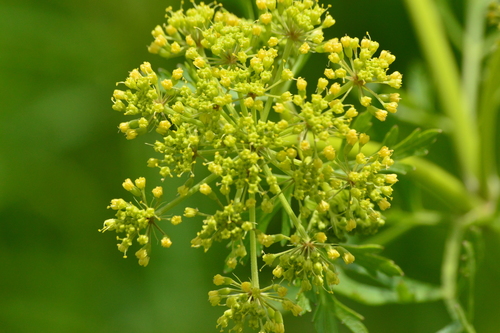
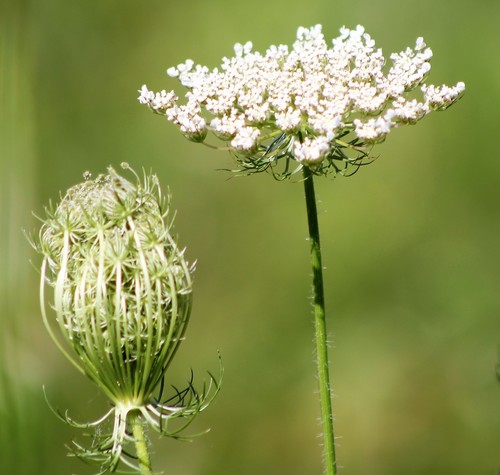
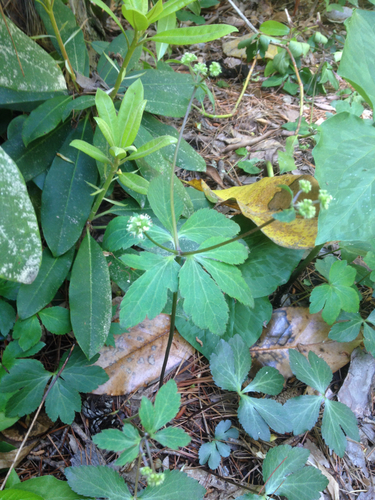
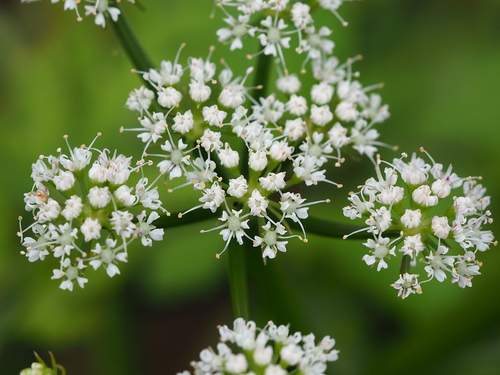
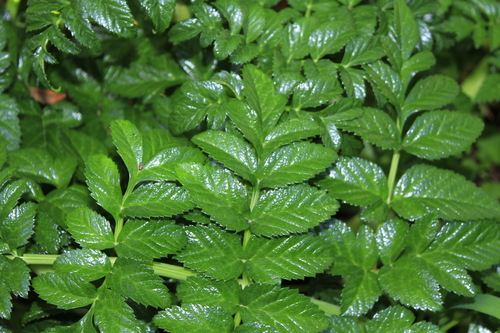
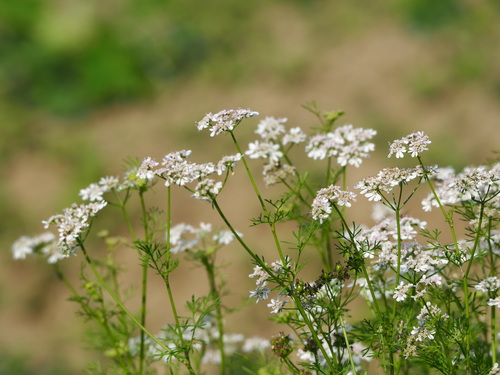
Coriandrum sativum L. is a soft herbaceous plant that grows up to 50 cm (20 in) tall. Its leaves vary in shape: they are broadly lobed at the base of the plant, and become slender and feathery higher up on the flowering stems. The small, white or very pale pink asymmetrical flowers are borne in umbels. Petals that point away from the center of the umbel are longer, measuring 5–6 mm (3⁄16–1⁄4 in), while petals that point toward the center are only 1–3 mm (1⁄16–1⁄8 in) long. Its fruit is a globular, dry schizocarp 3–5 mm (1⁄8–3⁄16 in) in diameter, and its pollen is approximately 30 μm (0.0012 in) in size.
Coriander is native to the Mediterranean Basin. It grows wild across a wide area of Western Asia and Southern Europe, which makes it hard to distinguish between regions where it is natively established and regions where it was only introduced recently. Recent research suggests that wild coriander growing in Israel and Portugal may be an ancestor of cultivated coriander. These wild populations have low germination rates, smaller vegetative growth than cultivated varieties, and Israeli wild coriander also has an extremely hard fruit coat.
Fifteen desiccated coriander mericarps were found in the Pre-Pottery Neolithic B layer (dated to six to eight thousand years ago) of Israel’s Nahal Hemar Cave, and eleven more were recovered from ~8,000–7,500 year old Pre-Pottery Neolithic C deposits at Atlit-Yam, also in Israel. If these finds are correctly associated with their archaeological layers, they are the oldest known examples of coriander in the world. Coriander is mentioned in the Torah as a reference for the taste of manna, which indicates it was a well-known ingredient in ancient Israel. Approximately 500 millilitres (17 US fl oz) of coriander mericarps were recovered from the tomb of Tutankhamen. Since coriander does not grow wild in Egypt, this find may be evidence that coriander was cultivated by ancient Egyptians. The Ebers Papyrus, an ancient Egyptian text dated to around 1550 BCE, records uses for coriander.
Coriander may have been cultivated in Greece since at least the second millennium BCE. One Linear B tablet recovered from Pylos notes that the species was cultivated to make perfumes, and that it was used in two forms: as a spice from its seeds, and as an herb for the flavor of its leaves. This record appears to be confirmed by archaeological evidence: large quantities of coriander recovered from an Early Bronze Age layer at Sitagroi in Macedonia may indicate that the herb was already cultivated there at that time.