About Corchorus olitorius L.
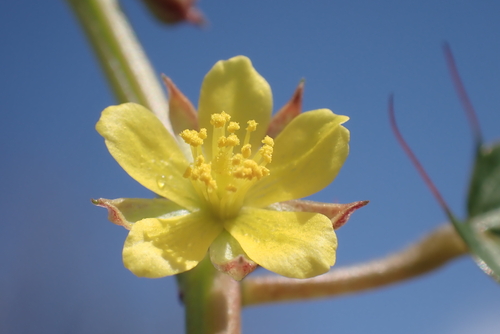
Corchorus olitorius L. is an erect, fairly branched herbaceous plant. It typically grows around 1.5 metres (5 ft) high, but when cultivated for fibre production, it can reach heights up to 4 m (13 ft). It has a taproot that gives rise to a sturdy, hairless stem which is green with a faint red-brownish hue, and sometimes becomes slightly woody at ground level. Its acute, serrate leaves are arranged alternately, measuring 6 to 10 centimetres (2+1⁄4 to 4 in) long and 2 to 4 cm wide. Flowers are borne singly or in two-flowered cymes opposite leaves. Each flower sits at the end of a short stalk, has 5 sepals, 5 petals, and 10 free yellow stamens. The fruit is spindle-shaped and dehiscent, divided into transverse sections by five valves. It measures 2 to 8 cm in length, and its colour ranges from greyish-blue to green or brownish-black. Each seed chamber holds 25 to 40 seeds, for a total of 125 to 200 seeds per fruit.
Corchorus olitorius is an annual crop. It grows well in lowland tropics, and can grow across a range of habitats from warm temperate zones through tropical deserts to wet forest life zones. It tolerates annual precipitation between 400 and 4290 mm, with 1000 mm per year being optimal. Some cultivars are sensitive to waterlogging, especially when young. The optimal temperature range for its growth is 16.8 to 27.5 °C. It requires a soil pH of 4.5 to 8.2. While the plant prefers fertile, humus-rich, well-drained alluvial soil, it also grows well in suboptimal soil conditions. Before sowing, the soil is carefully prepared by ploughing, and seeds are broadcast or dribbled behind the plough during the wet season. Twenty-four hours before seeding, seeds must be pre-soaked for ten seconds in hot water (around 93 °C) to break seed dormancy. Mixing the small seeds with sand makes sowing easier, and germination occurs two to three days after sowing if the soil is wet. In some cultivation systems, seedlings are transplanted when they reach 10 cm in height. Plants are grown in rows with 20–50 cm spacing. When plants reach 8–25 cm in height, seedlings are harrowed with a rake three to four times, and weeded two to three times. Manure options include cow dung, wood ashes, or rotted water hyacinth (Eichhornia crassipes) or its ashes. Crop yield responds more strongly to water availability and soil organic matter content than to high levels of mineral nutrients.
Jute fibre is made from the bark tissue of C. olitorius and C. capsularis, especially in South Asian countries, though fibre produced from C. olitorius is considered lower quality. Finished C. olitorius fibres are golden and silky, reaching up to 3 m in length with a diameter of 2.4 μm. To extract fibre, plant stalks are cut then processed by pulling up, rippling, partial retting, breaking, spinning and combing to obtain fine fibres that are fully separated from unwanted woody material. After processing, the fibres are cured and dried. Many textiles are made from jute, including yarn, twine, sacking, carpet backing cloth and other blended textiles. It is also used as a raw material for cords and strings. In Africa and the Middle East, a different type of C. olitorius is grown, where leaves and shoots are used for food and the fibre is considered to have little importance.
C. olitorius is cultivated as a potherb in Syria, Lebanon, Palestine, Tunisia, Sudan and Egypt, and its culinary use dates back at least to Ancient Egypt. It is an important leafy vegetable in Côte d'Ivoire, Benin, Liberia, Nigeria, Ghana, Cameroon, Sudan, Uganda, Kenya, Zambia and Zimbabwe. It is also cultivated and eaten in the Caribbean, Brazil, the Middle East, India, Bangladesh, Japan and China. Its leaves are a particular favourite of the Boros of northeast India, who make a mucilaginous preparation called narji from dried leaves mixed with fatty pork and lye. In Nigeria and Zambia, leaves are boiled to make a sticky, mucilaginous sauce that is served with otherwise dry cassava balls (called nshima in Zambia). In Vietnamese cuisine, it is known as rau đay and made into a soup with shrimp. In the Philippines, it is known as saluyot, and its young leaves are cooked in soups and stews such as Dinengdeng and Bulanglang. In Egypt, Sudan and Palestine, the dish mulukhiyah is made from its boiled leaves. In Tunisia, the leaves are ground into powder and cooked with beef or lamb.
Consumption of C. olitorius leaves is reported to have demulcent, deobstruent, diuretic, lactagogue, purgative, and tonic effects. It is also used as a folk remedy for aches and pains, dysentery, enteritis, fever, pectoral pains, and tumors. Ayurvedic practitioners use the leaves to treat ascites, pain, piles, and tumors. In other regions, the leaves are used to treat cystitis, dysuria, fever, and gonorrhea. A cold infusion of the leaves is said to restore appetite and strength. It can act as an anti-inflammatory, and has gastroprotective properties.