About Corallorhiza wisteriana Conrad
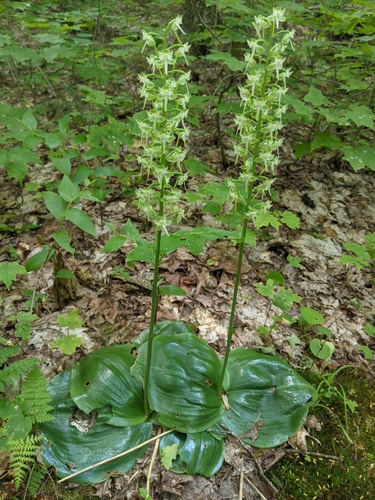
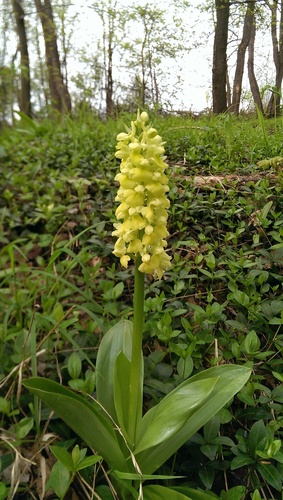
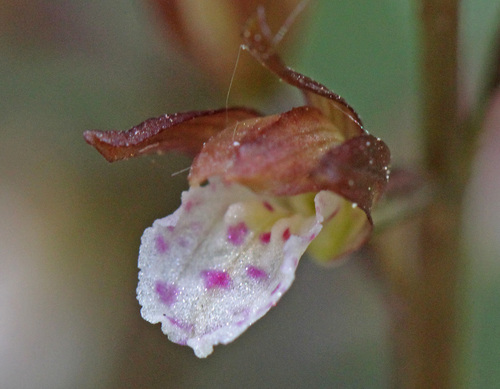
Corallorhiza wisteriana Conrad, commonly called spring coralroot, is a leafless orchid. Its stems, which function as the plant’s inflorescence, grow between 10 and 55 centimeters (4 and 22 inches) tall and do not have a thickened base. Stem colors can range from red-purple to yellowish-brown and yellow. The inflorescences are unbranched racemes, where the oldest flowers sit closest to the base of the stem, and flowers can be arranged sparsely or densely along the stem. Each stem produces between 2 and 25 flowers. No leaves grow on the stem, but a small bract sits beneath each flower where it attaches to the stem. Spring coralroot is native to a large range of North America, stretching from southern Mexico north to Montana in the United States. In Mexico, it occurs in southeastern Chiapas, southwestern Colima, Jalisco, Michoacán, and Oaxaca, central Ciudad de Mexico, State of Mexico, Morelos, and Tlaxcala, and northeastern Coahuila, Chihuahua, Hidalgo, and Nuevo León; in northwestern Mexico it is only found in Baja California Sur and Sonora. In the western United States, it has been recorded in widely scattered counties along the Rocky Mountains from New Mexico and Arizona north to Idaho and Wyoming. The USDA Natural Resources Conservation Service only documents the species in Phillips County, Montana, and also reports it from Jackson County, Oregon. The Flora of North America does not list Oregon as part of this species’ native range, but does note it occurs in Washington State without specifying a location. It has been recorded in four counties of western South Dakota, and two counties at opposite ends of Nebraska. Its range extends from southeastern Nebraska south to eastern Texas, and includes every US state eastward from this area; in the eastern US it grows as far north as New Jersey and Pennsylvania. It can be found at elevations ranging from sea level up to 3,100 meters (10,200 ft). It grows in both deciduous and coniferous woods, and frequently favors richer habitats than other coralroot species. For ecology: in Florida, this species gets most of its nutrients from the ectomycorrhizal fungi Russula amoenolens and Russula pectinatoides. In Mexico and the western United States, this orchid associates with fungi belonging to the family Thelephoraceae.