About Cophosaurus texanus Troschel, 1852
Common Name and Size Relative to Congeners
Cophosaurus texanus Troschel, 1852, commonly called the greater earless lizard, is a medium-sized lizard relative to other species in its range, and is the largest of the earless lizards.
Total Length Ranges by Subspecies
Multiple authors have reported a range of total lengths for this species, broken out by its recognized subspecies: for the Texas greater earless lizard (C. t. texanus), males measure 8.3–18.1 cm (3.3–7.1 in) and females measure 7–14.3 cm (2.8–5.6 in); for the Chihuahuan greater earless lizard (C. t. scitulus), males measure 9–18.4 cm (3.5–7.2 in) and females measure 6.7–13.5 cm (2.6–5.3 in).
External Ear Openings
Greater earless lizards have no external ear openings.
Scale Characteristics
Their body scales are small and granular, with dorsal scales slightly smaller than ventral scales.
Limb and Tail Morphology
They have relatively long legs, especially their hind legs, and a slightly flattened tail that is longer than the combined length of their head and body.
Underside of Tail Pattern
The underside of the tail is white with 5 to 9, usually 6 or 7, bold, contrasting black bands; this does not apply to individuals with regenerated tails.
Base Body Coloration
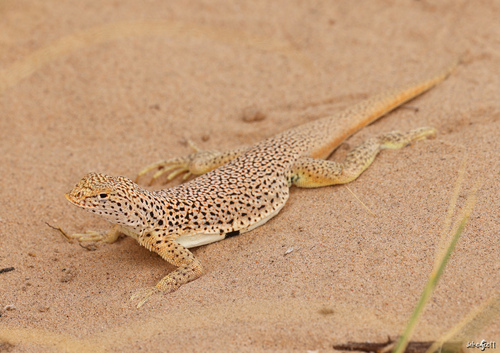
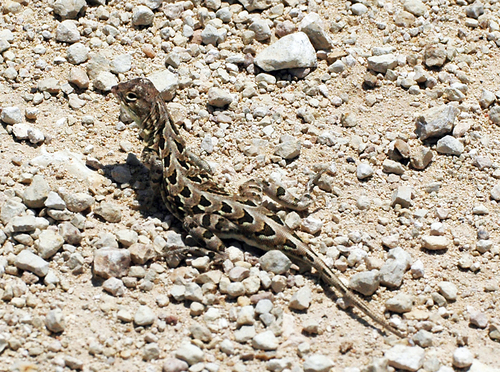
The lizard's base base can be any of various shades of gray, brown, tan, or reddish brown, and is generally close to the color of the local substrate it inhabits.
Sexual Dimorphism Overview
Cophosaurus texanus is a sexually dimorphic species; beyond size differences, males and females differ in some aspects of their coloration and markings.
Male Lateral Black Bands
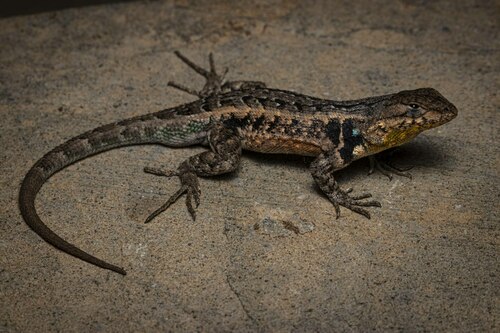
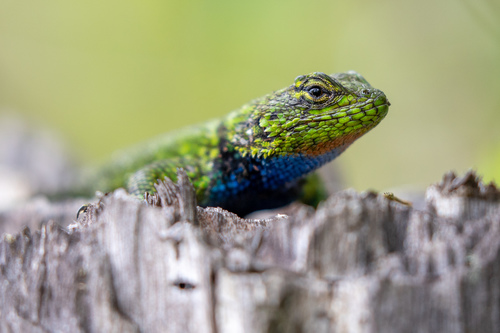
The most noticeable difference in males is a pair of black bands located on the posterior third of the body sides.
Male Band Origin and Structure
These bands rise from two blue patches on the belly margins, extend up the sides, arch forward, and end before meeting on the back.
Male Body Section Coloration
The body section anterior to the black bands has a pink, orange, or red tint, while the section posterior to the bands is shaded green, aqua-green, or lime-green.
Color Variation by Subspecies and Season
These colors are most prominent in the Chihuahuan greater earless lizard (C. t. scitulus), and all subspecies show greatly enhanced, more noticeable colors during the breeding season.
Regional Colloquial Name
In parts of the lizard's range, it is colloquially called "the lizard with the pink shirt and green pants."
Female Lateral Band Characteristics
By contrast, females either completely lack the black lateral bands, or have very faint, indistinct bands.
Female and Juvenile Markings
Females and young individuals often have a lateral white or near-white stripe running between the forelimbs and hind limbs, as well as on the back of the legs.
Subspecies Diagnostic Character Overview
The recognized subspecies are distinguished by the following diagnostic characters.
Cophosaurus t. texanus Diagnostic Traits
For Cophosaurus t. texanus: typically 80–86% of individuals have 79 ventral scales or fewer between the collar (last gular fold) and anus, 40 or more scales along head length, and 27 or fewer total femoral pores.
Cophosaurus t. scitulus Diagnostic Traits
For Cophosaurus t. scitulus: 80–84% of individuals have 80 or more ventral scales, 39 or fewer head scales, and 28 or more femoral pores.
Cophosaurus t. reticulata Diagnostic Traits
For Cophosaurus t. reticulata: 85–100% of individuals have 82 ventral scales, 36 or fewer head scales, fewer than 31 femoral pores, and males have faint black lateral bars that do not extend above the lateral fold.
Species-Wide Geographic Range and Elevation
The greater earless lizard occurs in the southwestern United States (Arizona, New Mexico, and Texas) and northern Mexico (Chihuahua, Coahuila, Durango, Nuevo León, San Luis Potosí, Sonora, Tamaulipas, and Zacatecas), across an elevation range from 127 to 2100 meters.
C. t. texanus Range (U.S.)
The Texas greater earless lizard (C. t. texanus) is found on the Edwards Plateau of Central Texas, northward to the Texas-Oklahoma state border, and into the southeastern Texas panhandle.
C. t. texanus Range (Mexico)
It ranges south into the Tamaulipan mezquital ecoregion, and along the Rio Grande into northeast Coahuila and north-central Nuevo León, Mexico.
C. t. texanus Southern Range Edge
Its occurrence becomes increasingly spotty and localized in south-central Tamaulipas, with records just across the southern Tamaulipas state line in eastern San Luis Potosí.
Subspecies Integration Zone Status
Multiple sources note that the integration zone between subspecies C. t. texanus and C. t. scitulus is problematic and poorly defined.
C. t. scitulus Range (U.S.)
The Chihuahuan greater earless lizard (C. t. scitulus) occurs across most of the Chihuahuan Desert, including much of the Trans-Pecos region of West Texas, the southern third of New Mexico (extending north along the Pecos and Rio Grande river basins), and southeastern Arizona (east of the Sonoran Desert).
C. t. scitulus Western Range Extension
It follows a zone of semi-arid habitats along the northeastern margins of the Sonoran Desert almost to the California border.
C. t. scitulus Range (Mexico)
In Mexico, its range includes northeastern Chihuahua, most of Coahuila, northeastern Durango, extreme northeastern Zacatecas, extreme southern Nuevo León, northern San Luis Potosí, and extreme southwestern Tamaulipas.
C. t. scitulus Sierra Madre Oriental Occurrence
It is absent from higher elevations in the Sierra Madre Oriental, but does range deeper into canyons and valleys on both the eastern and western versants of the mountain range.
C. t. reticulatus Range and Rarity
The Sonoran greater earless lizard (C. t. reticulatus) is endemic to northeastern Sonora, Mexico, between 470 and 1300 meters; as recently as 2016, it was only known from eight localities.
Broad Ecoregion Occupancy
The greater earless lizard is native to the arid environment of the Chihuahuan Desert, with its range extending into western areas of the Tamaulipan mezquital, the northeastern margins of the Meseta Central matorral, the semi-arid Edwards Plateau and Central Great Plains in Texas, and the Arizona transition zone between the Sonoran Desert and Arizona Mountains forests in the west.
General Habitat Preferences
Within these ecoregions, it typically occupies open scrubland and areas of sparse vegetation that feature rocks and boulders.
Preferred Rocky and Riparian Habitats
It often prefers limestone ledges and outcrops near streams with boulders and crevices, and dry gulches, arroyos, and canyons with alluvium deposits of silt, sand, gravel, and rocks, though it is not strictly limited to these areas.
Slope and Rock Type Habitat
Gentle to moderate slopes of limestone and gravel, and hills of granite and igneous rock also serve as habitat for this lizard.
Associated Plant Species
Plant species documented in association with greater earless lizards include honey mesquite (Prosopis glandulosa), creosote bush (Larrea tridentata), ocotillo (Fouquieria splendens), sotol (Dasylirion), lechuguilla (Agave lecheguilla), prickly pear cactus (Opuntia), leatherstem (Jatropha dioica), and candelilla (Euphorbia antisyphilitica).
Substrate Color Matching Example
An individual lizard's color often has a striking correlation to the prevailing color of the rocks and substrates it lives in; for example, specimens from Llano County, Texas have been noted to have a rusty brown color that matches the red granite common to the Llano Uplift.
Local Population Abundance
Cophosaurus texanus can be locally abundant, and is among the most common herpetofauna species in some areas, but is entirely absent from other areas that seem to have appropriate habitat.
Longevity
The typical longevity of the greater earless lizard is 3 years, though wild individuals have been documented surviving five reproductive seasons.
Growth and Sexual Maturation Timing
Both males and females reach adult size within one year, and attain sexual maturity and mate before their second winter.
Mating Period
Mating occurs from April to August, and peaks between late April and early July.
Gravid Female Coloration
Gravid females often develop pink, orange, or yellow coloration on their throats and sides.
Gravid Female Observation Period
One study only found gravid females in May and June.
Clutch Laying Behavior
Females lay multiple clutches per year, up to four, which are scattered across a wide area.
Clutch Size Variation
Clutch size ranges from 2 to 9 eggs, with an average of 3 to 5; more mature females produce larger clutches than younger females.
Egg Deposition Observations
One study reported finding single eggs buried in sand on three occasions, but never located a full buried clutch.
Incubation Period
The incubation period is approximately 50 days.
Hatchling Emergence and Size
Hatchlings emerge from June to October, with reported snout–vent lengths varying from 20 to 25 mm, or 26–31 mm depending on the source.