About Uma scoparia Cope, 1894
Species Naming and Body Shape
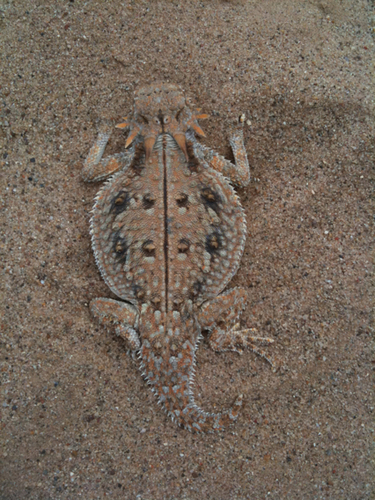
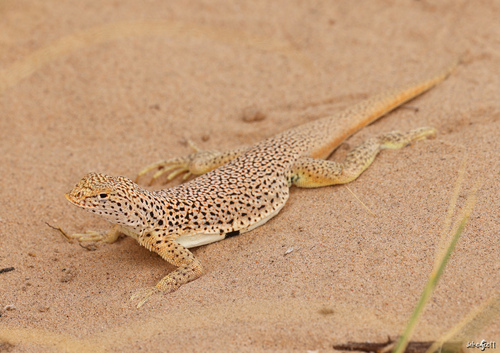
The Mojave fringe-toed lizard (Uma scoparia Cope, 1894) is a flat-bodied lizard with smooth skin.
Dorsal Coloration
Its skin color matches the surrounding environment it inhabits, ranging from tannish white to grayish white, and usually has small black spots along its back.
Throat Markings
On its underside, this species has up to three characteristic crescent-shaped throat markings.
Additional Identifying Traits
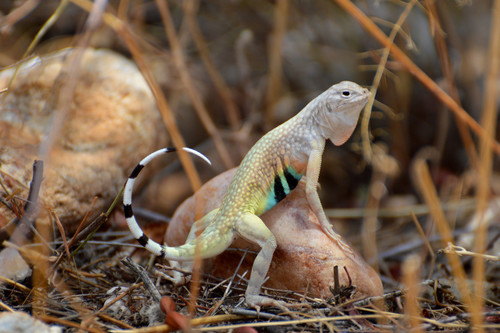
Other identifying traits of the Mojave fringe-toed lizard include dark bands on the tail and dark blotches on the sides of the belly.
Breeding Season Coloration
During breeding season, the dark blotches on the sides of the belly turn pink, and the lizard's underside becomes pale yellow.
Size and Tail Proportion
The lizard's tail is the same length as its body, and the total length of a full-grown individual is around 7 inches.
Male Territorial Behavior
Males are territorial and walk the perimeter of their home range to perform assertion displays; these displays are linked to reproduction rather than protection of resources.
Female Territorial Behavior
Females do not defend broad territories, but instead hold territoriality over a specific site.
Geographic Range
The geographic range of the Mojave fringe-toed lizard stretches from Inyo County, Los Angeles County, Riverside County, and San Bernardino County in California to La Paz County in western Arizona.
Habitat Type
Most individuals are limited to habitats with fine sand, including dry lake beds, desert washes, and hillsides.
Elevation Range
Their habitat occurs at elevations ranging from sea level up to 3000 feet.
Adult Hibernation
Adult Mojave fringe-toed lizards typically hibernate from November to February, burying themselves around one foot below the sand.
Juvenile Hibernation
Juveniles hibernate much closer to the sand surface; some juveniles do not hibernate at all and remain active year-round.
Spring Activity Pattern
In March and April, this lizard species is active for fewer hours than its close relatives in the genus Uma, due to the cooler temperatures of the Mojave Desert.
Sexual Maturity and Mating Period
The Mojave fringe-toed lizard reaches sexual maturity in its second year, and mating occurs in late spring.
Rainfall Impact on Breeding
The amount of rainfall affects the species' breeding output.
Clutch Size
Females usually lay 1 to 5 eggs per mating season, with an average clutch size of 2 to 3 eggs.
Egg Hatching and Nesting
Eggs hatch in September, and the lizards likely bury their eggs in sand, a trait shared with many other lizard species.
Migratory Behavior
This species does not perform seasonal migration.
Wet Winter Reproductive Benefit
More young are produced following wet winters, likely due to the resulting higher abundance of spring annual plants and insects.