About Conospermum longifolium Sm.
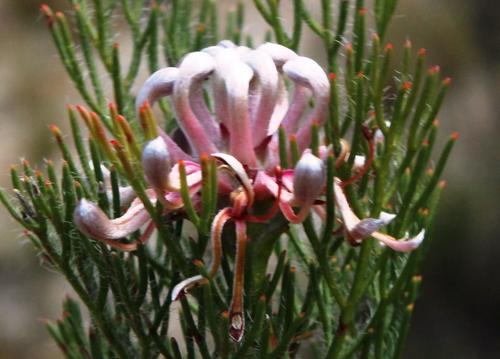
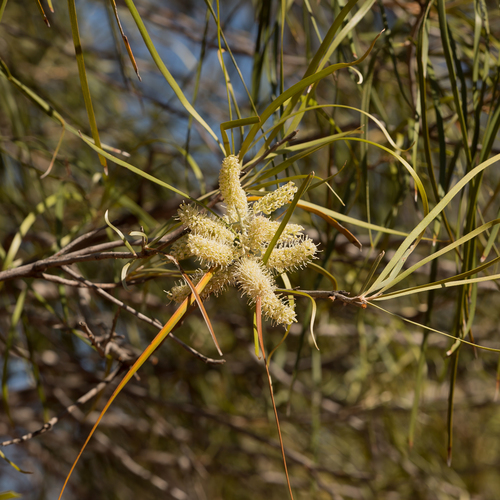
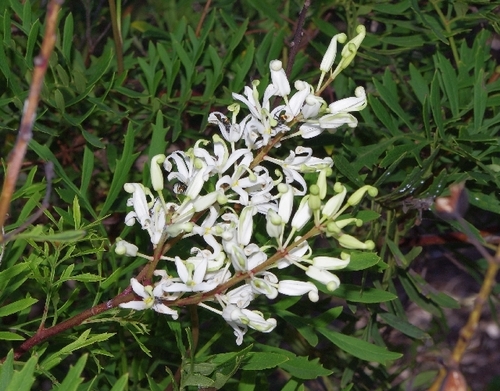
Conospermum longifolium Sm. is commonly known as long leaf smokebush. It is a dense shrub or undershrub that usually grows up to 2.5 metres (8 feet 2 inches) tall, and its entire surface is covered in fine hairs. Its leaves are linear to narrowly lance-shaped, with the narrower end at the base. Each leaf measures 35 to 190 millimetres (1.4 to 7.5 inches) long and 1 to 27 millimetres (0.039 to 1.063 inches) wide, and is glabrous and sessile. Its flowers are arranged in panicles holding up to 4 flowers each, borne on a peduncle 100 to 250 millimetres (3.9 to 9.8 inches) long. The bracteoles are glabrous and egg-shaped, measuring 1.6 to 3.8 millimetres (0.063 to 0.150 inches) long and 1.0 to 2.5 millimetres (0.039 to 0.098 inches) wide. The perianth is white, forming a tube 1.7 to 6 millimetres (0.067 to 0.236 inches) long. The upper lip of the perianth is egg-shaped, 1.5 to 3.5 millimetres (0.059 to 0.138 inches) long and 1.8 to 2.5 millimetres (0.071 to 0.098 inches) wide. The lower lip is joined for 1.2 to 2.5 millimetres (0.047 to 0.098 inches) and has elliptic lobes 1.5 to 2.6 millimetres (0.059 to 0.102 inches) long and 0.8 to 1 millimetre (0.031 to 0.039 inches) wide. This species flowers in spring. Its fruit is a hairy, cream-coloured to dark brown nut 2 to 3 millimetres (0.079 to 0.118 inches) long that is covered in golden hairs. Long leaf smokebush grows in forest, woodland, and heath habitats on sandy soils. It occurs along the coast and ranges of New South Wales, Australia, between Newcastle and Ulladulla. Three subspecies have distinct ranges: subspecies angustifolium is restricted to the area between Waterfall and Appin; subspecies longifolium occurs mainly in coastal areas between Port Jackson and Lake Conjola; and subspecies mediale occurs mainly in the Blue Mountains between Putty and Moss Vale.