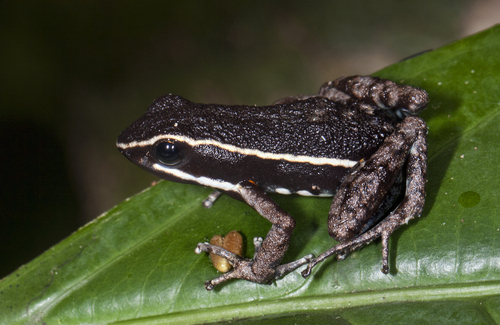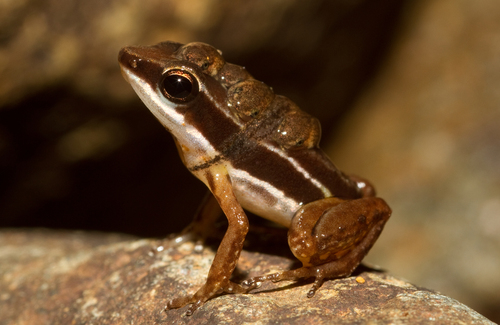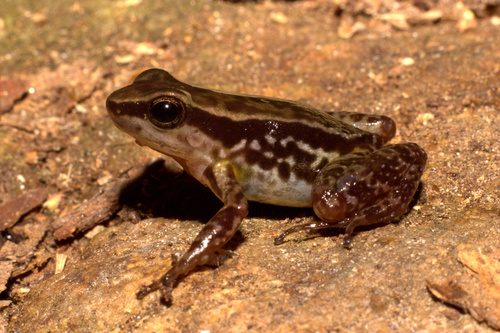
About Colostethus ruthveni Kaplan, 1997
Taxonomic Status
"Colostethus" ruthveni is a species of frog in the family Dendrobatidae whose evolutionary relationships are unresolved.
Distribution
It is endemic to the lower north-western slopes of the Sierra Nevada de Santa Marta, found only in the mountains of northeastern Magdalena Department, northern Colombia, at elevations between 450 m and 2100 m above mean sea level.
Habitat and Threats
Its natural habitats are tropical dry forests and cloud forests, where it lives near streams; this species is threatened by habitat loss.
Etymology
The specific name ruthveni honors Alexander Grant Ruthven, an American herpetologist.
Size
On average, males of this species have a snout-vent length of 18.9–20.1 millimetres (0.74–0.79 in), while females average 19.8–24.1 millimetres (0.78–0.95 in).
Original Description
This species was first scientifically described in 1997 by Kaplan, who placed it in the genus Colostethus. At that time, Colostethus was a "wastebasket taxon" that grouped together multiple unrelated lineages of non-aposematic, drab-coloured dendrobatoid frogs.
Generic Placement
Researchers now confirm that "C." ruthveni is almost certainly not a true Colostethus (rocket frog), nor does it belong to Hyloxalus, the genus that holds most species previously placed in Colostethus. Instead, it is more closely related to the typical bright-coloured poison-dart frogs of the subfamily Dendrobatinae.
Cryptic Species Complex
As of 2019, this species forms a cryptic species complex with other slightly distinct frogs that have not yet been scientifically described; these undescribed frogs occur on the northern and northeastern slopes of the Santa Marta massif in La Guajira Department, and on the southern slopes of the massif in Cesar Department.
Current Phylogenetic Uncertainty
As of the 2020s, the broader relationships of "Colostethus" ruthveni remain elusive, even after substantial study.
Evolutionary Position
Based on what is known of the species' reproductive behavior and tadpole anatomy, this endemic Santa Marta frog lineage appears to be an early branch of the dendrobatines, only barely more advanced than the very ancient genus Phyllobates, and may represent a distinct, unrecognized genus.