About Cocos nucifera L.
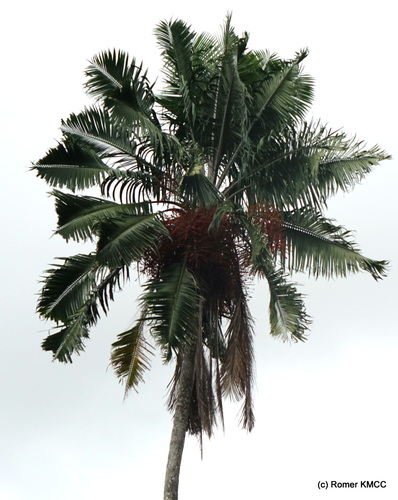
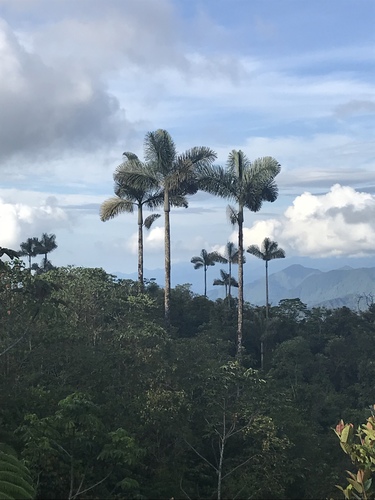
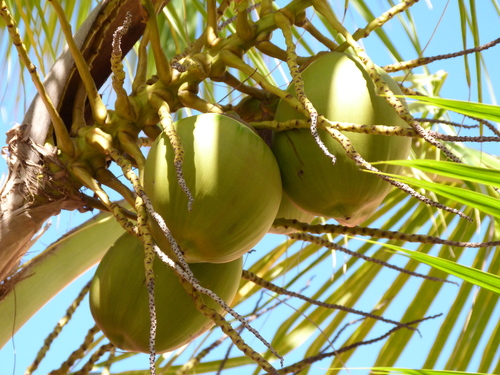
Cocos nucifera (coconut palm) is a large palm that can grow up to 30 meters (100 feet) tall. It has pinnate leaves 4–6 meters (13–20 feet) long, with individual pinnae 60–90 centimeters (2–3 feet) long. Old leaves break away cleanly from the tree, leaving the trunk smooth. On fertile soil, a tall coconut palm produces around 80 fruits per year, while newer cultivars may yield as many as 150 fruits per year. In India, the average annual production is over 8,000 nuts per hectare. Tall varieties produce their first fruit 6 to 10 years after planting, and live 60 to 100 years. Dwarf varieties begin producing fruit more quickly, but have shorter lifespans. Due to human cultivation and dispersal, coconuts now have a nearly cosmopolitan distribution. Their original native distribution was in the Central Indo-Pacific, covering the regions of Maritime Southeast Asia and Melanesia. The coconut palm thrives in sandy soils and is highly tolerant of salinity. It prefers areas with abundant sunlight, regular annual rainfall between 1500 mm and 2500 mm, and humidity above 60%. If annual rainfall is lower than this range, it can survive as long as its roots can reach the soil water table, but it cannot tolerate waterlogging. In the tropics, it grows from sea level up to an altitude of 600 meters (2,000 feet). It can tolerate a one-month dry season when growing on inland sandy soils, and up to a three-month dry season when growing on heavier soils, but the soil must always be free-draining. It can grow in soils with a pH of 4.5 to 8 (pH 8 most commonly occurs on coral atolls), but prefers a pH range of 5.5 to 7. Shade severely limits its growth. If it has developed a healthy, well-established root system, it can withstand hurricane-strength winds. Wild coconuts are only found in coastal areas with sandy, saline soils. The coconut fruit is adapted for dispersal by ocean currents, and coconuts could not naturally reach inland locations without human intervention to transport seeds and plant seedlings. Coconut palms are normally cultivated in hot, wet tropical climates. They require year-round warmth and moisture to grow well and produce fruit. They are difficult to establish in dry climates, and cannot grow there without frequent irrigation. In drought conditions, new leaves do not open properly, older leaves may dry out, and developing fruit may be shed. The expansion of coconut palm cultivation in the tropics is threatening a number of natural habitats, including mangroves; one documented example of this habitat damage is the Petenes mangroves of the Yucatán. Uniquely among tree species, coconut palms can be irrigated with saltwater. The coconut palm is grown throughout the tropics both as an ornamental plant and for its wide range of culinary and non-culinary uses. Virtually every part of the coconut palm is used by humans in some form, giving the species significant economic value. Its great versatility is reflected in its common nicknames: in Sanskrit it is called kalpa vriksha, meaning "the tree of the necessities of life"; in Malay it is pokok seribu guna, meaning "the tree of a thousand uses"; and in the Philippines it is commonly called the "tree of life". It is widely recognized as one of the most useful tree species in the world. Among its many non-food uses, coconut husk and shell can be used as fuel or processed into charcoal. Husks can also be used as flotation devices or as an abrasive. When coconut shells are removed from the husk and heated on warm ashes, they release an oily material that is used to soothe tooth pain in traditional Cambodian medicine. Coir fiber extracted from coconut husks is used to make ropes, mats, brushes, sacks, and boat caulking, and as stuffing for mattresses. It is also used in horticulture as a component of potting compost, especially for orchid mixes, and to make brooms in Cambodia. Historically, coconut cups were often carved with relief scenes and decorated with precious metals. Coconut leaves provide material for baskets and roofing thatch; they can also be woven into mats, used to make cooking skewers and kindling arrows, and woven into small pouches that are filled with rice and cooked to make the dishes pusô and ketupat. Native Hawaiians traditionally hollowed coconut palm trunks to make drums, containers, and small canoes. The leaf petioles (called "branches" in common use) are strong and flexible enough to be made into switches. In 2005, the use of coconut branches for corporal punishment was revived in the Gilbertese community on Choiseul, Solomon Islands. Coconut roots are used to make dye, as a mouthwash, and as a folk medicine to treat diarrhea and dysentery. A frayed piece of coconut root can also be used as a toothbrush. Roots are also used in traditional Cambodian medicine. Coconut meal, the leftover fiber from coconut oil and coconut milk production, is used as livestock feed. The dried calyx is used as fuel in wood-fired stoves. Coconut water is traditionally used as a growth supplement in plant tissue culture and micropropagation.