About Thrinax radiata Lodd. ex Schult. & Schult.f.
Growth Form
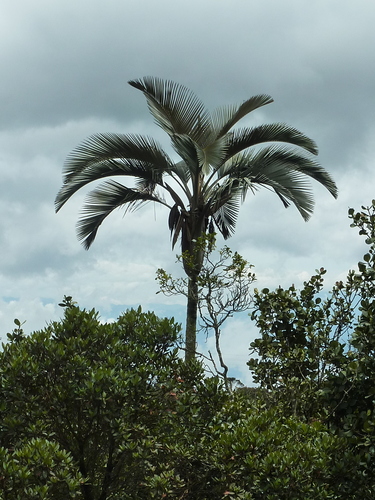
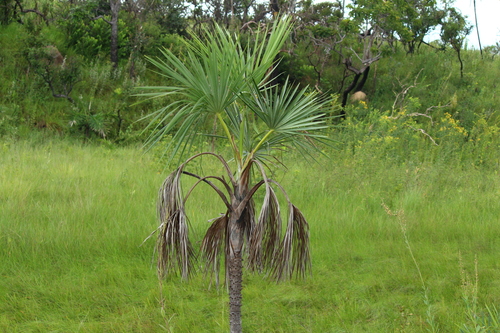
Like all palms, Thrinax radiata grows thick and low to the ground before sending its meristem vertically, developing the form of a slender tree. This species has no crownshaft, so its canopy appears to emerge directly from the trunk.
Average Height
On average, this species reaches a height of 20 feet.
Leaf Dimensions
It has large, compoundly segmented leaves that are 4 to 5 feet wide and 2.5 feet long.
Leaf Structure
The leaves are palmate and divide into segments about halfway down their length; the leaf emerges from the petiole in a shape described as a pointed hastula.
Canopy Size and Growth Rate
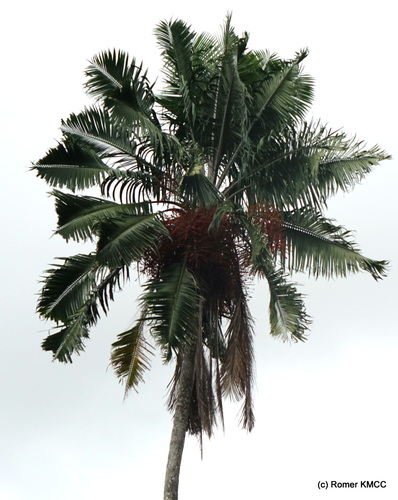
The entire canopy holds between 10 and 20 large leaves, and on average the species gains only 6 inches of height per year.
Canopy Shape Variation
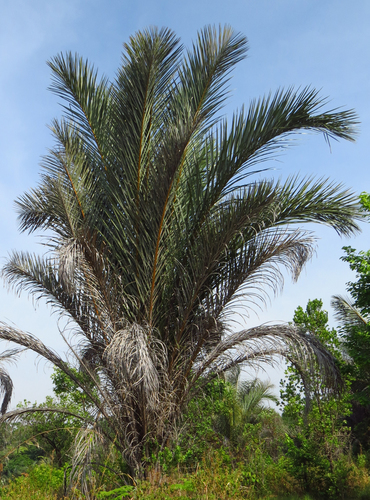
Canopy shape varies based on insolation levels: full sun specimens have a more globular or compact canopy, while shaded specimens have a longer, more spread-out canopy.
Flowering Threshold
This species can flower when it is only 6 feet tall.
Inflorescence Characteristics
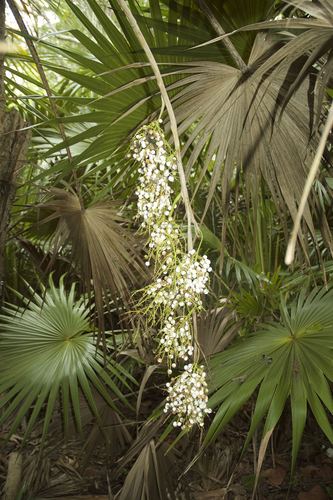
Its inflorescences exceed 3 feet in length, arch downwards, and can extend below the frond.
Flower Traits
The flowers are white, bisexual, and occur year-round, with peak production in the spring.
Fruit Characteristics
The resulting fruits, called drupes, are white and can also be seen year-round.
Genus Distinction by Fruit
It can be distinguished from the similar-looking genus Coccothrinax by its white drupes; drupes in Coccothrinax are black or yellow.
Genus Distinction by Leaf Bases
Another distinguishing feature of Thrinax is its split leaf bases, while Coccothrinax has fused leaf bases.
Environmental Tolerances
In the wild, this species almost always grows close to coastal areas, and is adapted to tolerate heavy winds, high salt concentrations, and even drought.
Soil Preferences
It naturally grows in sandy and calcareous soils, and does best in high pH soil.
Native Range
This species is native to southern Florida, the Florida Keys and Puerto Rico (United States), western Cuba, the Bahamas, the Cayman Islands, Jamaica, Hispaniola (the Dominican Republic and Haiti), the eastern coast of the Yucatán Peninsula (Mexico), Belize, Honduras, and Nicaragua.
Coastal Habitat
Thrinax radiata is found primarily in coastal scrub areas ranging from the Caribbean to Mexico, and can even grow on exposed limestone.
Other Habitats
It is also occasionally found in pinelands in South Florida and semi-evergreen forests in the Yucatán Peninsula.
Seed Dispersal
Its seeds are eaten and presumably dispersed by many animals including bats, spider monkeys, toucans, armadillos, and deer.
Faunal Associations
Young leaves are also eaten by spider monkeys, and mature leaves serve as a refuge for several bat species.
Invasive Threat
In Florida, particularly on Elliott Key, the invasive Mexican gray squirrel (Sciurus aureogaster) has had an extremely negative impact on T. radiata populations.
Squirrel Impact Mechanism
It uses palm fibers as nesting materials and consumes the palm itself, often killing the plant.
Landscaping Use
This species is commonly used as a landscaping tree along roadways and in residential areas in South Florida (hardiness zones 10b and 11a).
Cultivation Range
Today, it is widely planted outside of its natural historic range in South Florida and the Caribbean due to its ability to grow under various conditions.
Horticultural Use
It is used by gardeners, and can be grown in containers or in arboretums, which showcase this species' prolific inflorescences and fruit.
Common Name Origin
Its common name derives from the use of its fronds in thatched roofing.
Frond Uses
Its fronds are the most widely used part of the palm, and are utilized in broom construction, handicrafts, and food wrapping.
Fruit Edibility
The white fruit of T. radiata is edible.
Trunk Use
In the Yucatán Peninsula, its trunks have recently been used by local fishermen to construct lobster traps.