About Clevelandia ios (Jordan & Gilbert, 1882)
Species and Size
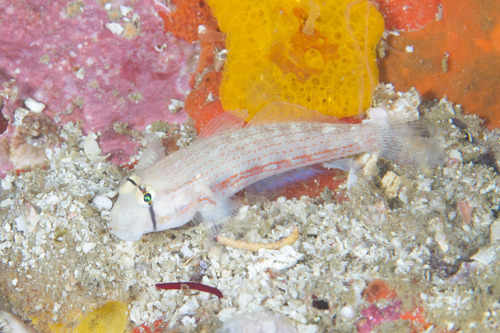
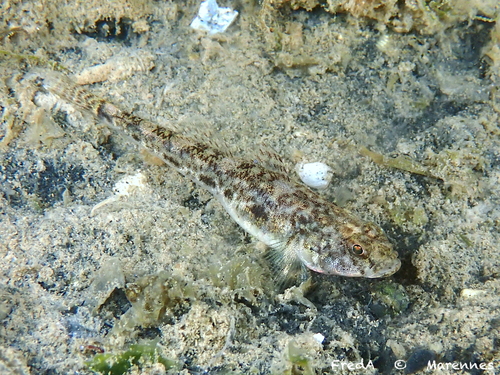
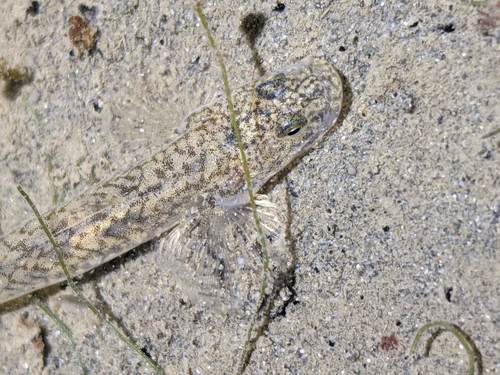
The arrow goby, Clevelandia ios, is a small translucent pale fish that reaches a maximum total length of 6.4 centimetres (2.5 inches).
Dorsal Fin Structure
It has two separate dorsal fins: the first is shorter, with 4 to 5 spines, while the second dorsal fin has 15 to 17 soft fin rays.
Anal Fin Structure
Its anal fin is roughly the same length as the second dorsal fin and has 14 to 17 fin rays.
Caudal and Pectoral Fins
Like other gobies, this species has a rounded caudal fin, and its pectoral fins form a cone that the goby uses to prop the front of its body above the underwater substrate.
Scales and Mouth
Arrow gobies have very small scales, and their mouth extends past the back of the eye.
Coloration and Fin Markings
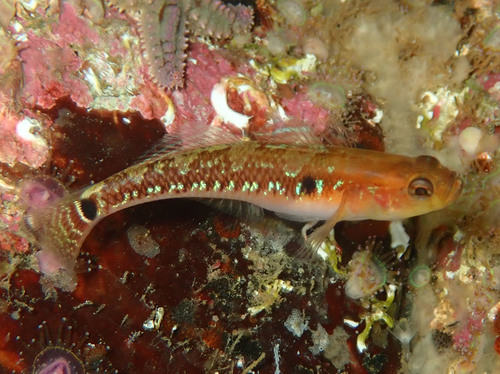
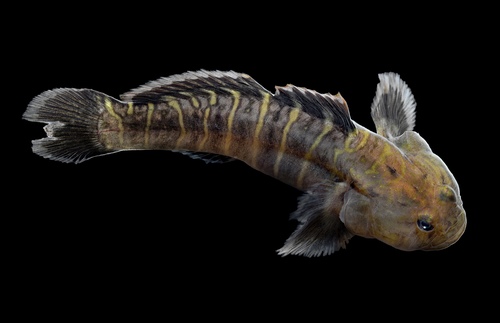
Their bodies are pale brownish-grey with darker mottling, and their dorsal fins bear short horizontal stripes.
Geographic Range
This species is found along the Pacific Coast of North America, ranging from Rivers Inlet in British Columbia, Canada, down to Baja California, Mexico.
Substrate and Burrow Use
Arrow gobies live on sand or mud substrates, where they use burrows dug by invertebrates as shelter when threatened and as a low tide refuge.
Burrow Host Species
Burrows commonly used by this species are made by the shrimp Neotrypaea californiensis, the shrimp Upogebia pugettensis, and the fat innkeeper worm Urechis caupo.
Habitat Types
It is a common species in estuaries, lagoons, and tidal sloughs, and has also been recorded in freshwater.
Adult Diet
Adult arrow gobies feed on diatoms, green algae, tintinnids, and the eggs and young of their burrow host shrimp or prawn.
Food Processing Behavior
This species will position large food items near crabs so that the crab can tear the food into smaller, eatable pieces.
Predators
Arrow gobies are preyed on by Sebastes rockfish, staghorn sculpins, whitespot greenlings, and terns.
Reproductive Strategy
This species does not build nests or provide any parental care for its offspring, and it releases its eggs directly into the open water column to disperse.
Threat Response Signaling
The underside of the arrow goby is silvery; when threatened, individuals use this silvery underside to send a brief signal to other arrow gobies before quickly retreating into a burrow.
Mating Signaling
This silvery signal is also used to attract potential mates.
Sexual System
All individuals of this species are protogynous hermaphrodites: young adults are female, and they transition to male as they grow to full maturity.