About Clerodendrum thomsoniae Balf.f.
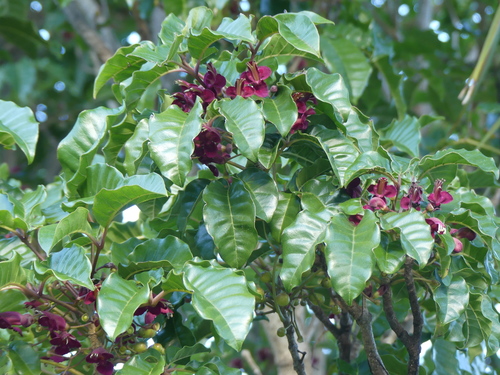
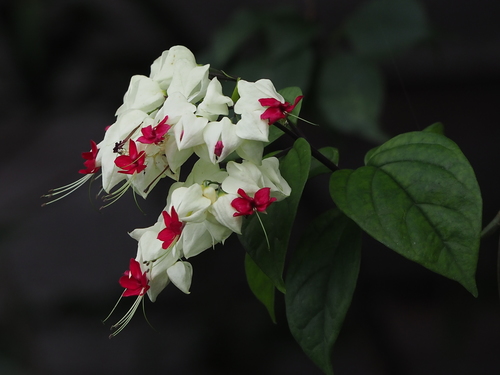
Clerodendrum thomsoniae Balf.f. is a species of flowering plant in the genus Clerodendrum of the family Lamiaceae, native to tropical west Africa, ranging from Cameroon westward to Senegal. It is an evergreen liana that grows up to 4 m (13 ft) tall. Its leaves are ovate to oblong, 8–17 cm (3–7 in) long; they are arranged opposite one another, positioned at right angles to the leaf pairs above and below them. Flowers are produced in cymes of 8 to 20 individual blooms, born on cymose inflorescences that arise from leaf axils. Each flower has a pure white to pale purple five-lobed calyx 2.5 cm in diameter, and a red five-lobed corolla 2 cm long and in diameter. The only unambiguous common name for this species is bleeding glory-bower; the terms "glory-bower", "bagflower", or "bleeding-heart vine" are also commonly used, but these names can refer to any of the roughly 400 species in the genus Clerodendrum. This species is grown as an ornamental plant, valued for its decorative two-coloured flowers. In some regions, it has escaped from cultivation and become naturalized. It requires a minimum temperature of 10–13 °C (50–55 °F), so in temperate areas it needs shelter and a frost-free environment. This plant has gained the Royal Horticultural Society's Award of Garden Merit, confirmed in 2017. The species was named at the request of Rev. William Cooper Thomson (1829-22 March 1878), a missionary and physician working in Nigeria, to honor his late first wife. During the mid 19th century, this plant was very popular under the name "beauty bush". It fell out of favor only after its unusual specific culture conditions were forgotten. Specifically, its root system must be partially submerged in water most of the time, and it requires very good light.