About Clematis virginiana L.
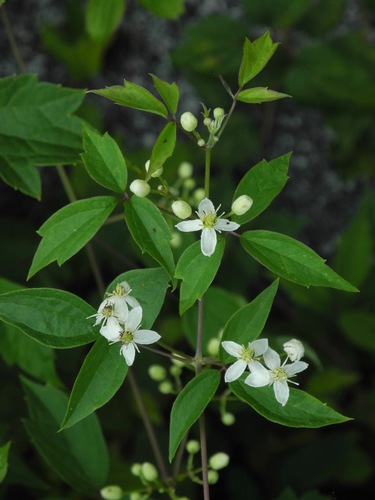
Clematis virginiana L. is an aggressively growing vine that climbs to heights of 3–6 m (10–20 ft) by twisting its leafstalks. Its leaves are opposite, pinnately compound, and trifoliate, meaning they have 3 leaflets, with coarse, uneven teeth along their margins. This species produces small dull white flowers that measure 13 to 19 mm (1⁄2 to 3⁄4 in) wide from July to September. The flowers have a faint sweet fragrance, and the species is sometimes dioecious, meaning it has separate male staminate and female pistillate plants. Male plants produce slightly showier flowers and do not produce seed. Its dry fruit is an achene, which develops long silvery gray feathery hair-like plumes from late August to November. Clematis virginiana naturally grows on woodland edges, moist slopes, fence rows, thickets, and streambanks. It tolerates growing conditions from full sun to light full shade, and adapts well to many soil types, ranging from sandy to clay, dry to freely draining wet, and acid to alkaline, with a pH range of 6.0 to 8.5. It has a deep but sparse fibrous root system, which makes it difficult to transplant. This plant acts as a larval host for the clematis clearwing moth (Alcathoe caudata). It is suited for USDA hardiness zones 3 to 8, and is not commonly planted in most gardens and landscapes. However, it is sold by some native plant nurseries, some specialty nurseries, and some large conventional nurseries. What most conventional nurseries and garden centers usually sell instead is the similar sweet autumn clematis, Clematis terniflora. This species is favored for its heavier leaf coverage, pleasant aroma, and ability to grow better in shade. Due to its tendency to self-sprout, the rampant growing sweet autumn clematis can quickly become invasive when introduced into the native habitat of Clematis virginiana.