About Clematis occidentalis (Hornem.) DC.
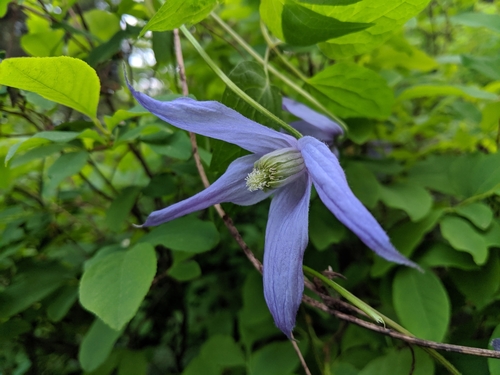
Clematis occidentalis (Hornem.) DC. bears compound leaves made of three leaflets. Each leaflet measures 1.5 to 3.5 inches long and up to 2 inches wide, with either smooth toothless edges or a small number of shallow teeth. Leaflets have sharply pointed tips and attach to a hairy stalk. Their shape can vary from egg-shaped, teardrop-shaped, or heart-shaped, and occasionally split into two or three irregular lobes. Leaflet surfaces are either hairless or sparsely hairy, and sometimes become fully hairless over time. This species does not grow tendrils on its stems. Instead, its leaf stalks twine around nearby vegetation and structures to gain support. Stems are mostly round to squarish, generally hairless, and may show a purplish color, with the lower portion of the stem becoming woody. Single flowers grow from the leaf axils of Clematis occidentalis, and these flowers are 1.5 to 2.5 inches long. The blossoms have four petal-like sepals, which range in color from blue-violet to pinkish-purple. The sepals are oblong-elliptic, hairy, and arranged in a drooping to somewhat spreading pattern. Flower stalks are sparsely hairy and measure 2 to 4 inches long. At the center of the flower sits a prominent column formed by many stamens that surround a bundle of styles. Staminodia are typically found surrounding this central column. These staminodia are flat, white with visible veins that are often tinged pink. Clematis occidentalis produces plume-like fruit. After flowering, the plant develops heads of finely hairy seeds, each with an elongated tail-like structure around 2 inches long. As seeds ripen, they change color from green to rusty brown, while the tails become grey and feathery. Mature seeds are dispersed by wind.