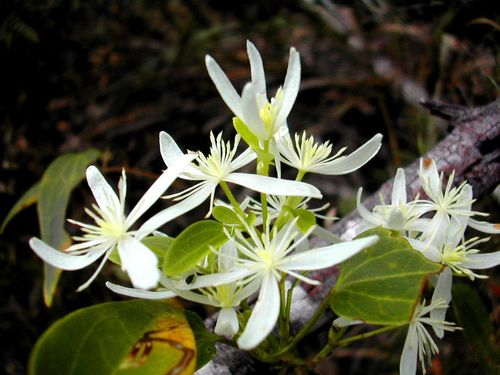
About Clematis glycinoides DC.
Clematis glycinoides DC. is a woody-stemmed vine that can grow up to 15 m (49 ft) in length. It bears simple, lanceolate (spear-shaped) to oblong leaves, which measure 1.5–12 cm (0.59–4.72 in) long and 1–8 cm (0.39–3.15 in) wide. Cream-white flowers of this species appear from July to December, reaching peak abundance in September. This species is dioecious, meaning individual plants produce only male or only female flowers. Its seedheads hold multiple feathery tails that can grow up to 6 centimetres (2.4 in) long. Clematis glycinoides is native to Queensland, New South Wales, and Victoria, where it grows in woodland, forests, and rainforests. It favors well-drained soils formed from basalt, limestone, shale, or sandstone. It grows under a variety of open forest tree species, including Backhousia myrtifolia (grey myrtle), Eucalyptus paniculata (grey ironbark), and Eucalyptus viminalis (manna gum), as well as floodplain forest trees such as Eucalyptus amplifolia (cabbage gum) and Angophora subvelutina (broad-leaved apple). Honeybees are known to visit the flowers of this species. When grown in cultivation, Clematis glycinoides is possibly less vigorous than other Clematis species, and it requires moist conditions to thrive. Its white flowers are recognized as an attractive feature of the plant.