About Cladrastis kentukea (Dum.Cours.) Rudd
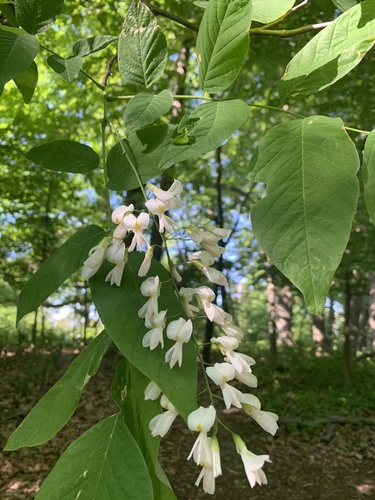
Cladrastis kentukea, commonly known as Kentucky yellowwood, is a small to medium-sized deciduous tree. It typically grows 10–15 metres (33–49 ft) tall, and may exceptionally reach 27 metres (89 ft) in height, with a broad rounded crown and smooth gray bark. Its leaves are pinnately compound, 20–30 cm (7.9–11.8 in) long, and bear 5 to 11 (most often 7 to 9) alternately arranged leaflets. Each leaflet is broadly ovate with an acute apex, 6–13 cm (2.4–5.1 in) long, 3–7 cm (1.2–2.8 in) broad, with a smooth entire margin and a thinly to densely hairy underside. In autumn, leaves turn a mix of yellow, gold, and orange, or a bright clear yellow. The tree produces fragrant, white, papilionaceous flowers in Wisteria-like drooping racemes (terminal panicles) 15–30 cm (5.9–11.8 in) long, sometimes reaching 30 to 36 cm in total length. Flowering occurs in early summer (June in the tree's native region), and flowering is inconsistent from year to year, with heavy bloom every two or three years. The flower has a five-lobed campanulate calyx that is enlarged on the upper side; a papilionaceous corolla with a broad white standard marked by a pale yellow blotch on the inner surface, oblong wings, and free keel petals; ten free stamens with thread-like filaments; and a superior, linear, bright red, hairy ovary with a long incurved curved style. The fruit is a smooth, linear-compressed legume pod 5–8 cm (2.0–3.1 in) long, tipped with remnant style tissue, that contains 2 to 6 dark brown seeds. Its bark is smooth gray or light brown. Young branchlets are initially downy, but quickly become smooth and light yellowish green, later turning red brown, and finally dark brown. Its wood ranges from yellow to pale brown; it is heavy, hard, close-grained, and strong, with a specific gravity of 0.6278, and weighs 39.12 lb (17.74 kg) per cubic foot. Winter buds form in groups of four, creating a tiny cone that is enclosed in the hollow base of the leaf petiole. The leaf main stem is stout, and enlarged at its base. Leaflets are broadly oval to wedge-shaped at the base, with the terminal leaflet typically rhomboid-ovate; leaves are feather-veined, with prominent midrib and primary veins that are grooved on the upper surface and light yellow on the underside. Newly emerged leaves are pale green and downy, becoming dark green on the upper surface and pale on the underside when fully grown. Cladrastis kentukea is one of the rarest native trees of eastern North America. It is found primarily on limestone cliffs in Kentucky, Tennessee, and North Carolina, and is hardy as far north as USDA hardiness zone 4. The largest known specimen, measured by trunk volume, grows at Spring Grove Cemetery in Cincinnati, Ohio, reaching 22 m (72 ft) tall with a 2.2 m (7 ft 3 in) trunk diameter; the tallest known specimen is a slender tree 27 m (89 ft) tall with a 0.55 m (1 ft 10 in) trunk diameter, located at Plott Cove Research Natural Area, Georgia. Some specimens from Alabama with especially hairy undersides on young leaves have been classified as Cladrastis kentukea f. tomentosa (Steyermark) Spongberg, but this form is not considered a taxonomically significant variation. Cladrastis kentukea is widely grown as an ornamental tree valued for its attractive flowers, and is locally naturalized in many areas of the eastern United States outside its limited native range. It grows best in full sunlight and well-drained soil, and tolerates both high pH alkaline soils and acidic conditions. It can tolerate urban growing conditions, and its flowers and foliage attract birds. Several cultivars have been selected, including 'Perkin's Pink' (also called 'Rosea', an invalid name) which produces pink flowers. Kentucky yellowwood is widely recommended as one of the best medium-sized ornamental trees for garden cultivation. The only commonly noted growth characteristic that may be undesirable for some planting settings is its tendency to develop multiple trunks by branching very close to the ground. The common name yellowwood comes from its yellow heartwood, which is used in small quantities for specialty furniture, gunstocks, and decorative woodturning. It is classified as a pollinator plant that supports and attracts bees and butterflies.