About Cirsium heterophyllum (L.) Hill
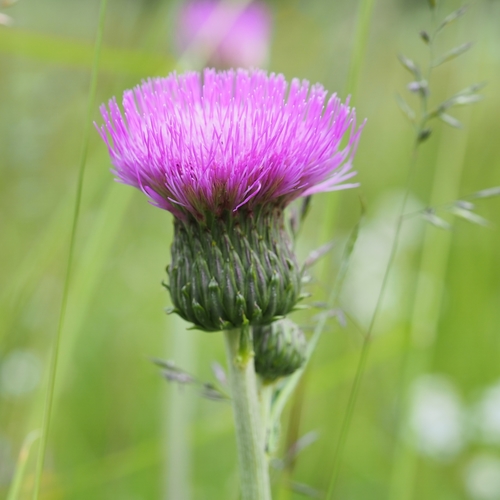
Unusually for a thistle, Cirsium heterophyllum lacks spines. This plant grows 45–120 cm (18–47 in) tall and forms creeping stolons, or runners. Its stem is grooved, unwinged, more-or-less branchless, and cottony. Its leaves are green and hairless on the upper surface, with a thick white felt covering on the underside. Basal leaves are lanceolate, borne on petioles, have softly prickly edges, and reach 20–40 cm (7.9–15.7 in) long and 4–8 cm (1.6–3.1 in) wide. Upper leaves lack petioles and clasp the stem with heart-shaped (cordate) bases. The flower heads measure 3 to 5 cm in both length and width, and hold red-purple flowers that bloom from July to August. Cirsium heterophyllum is native to northern Europe and Central Asia. It is native to upland areas of Scotland, northern England, and north Wales, but rare across other parts of Great Britain and Ireland. It occurs throughout Scandinavia, in north central Europe and Russia extending to approximately 100 degrees East, and in the high mountains of southern Europe. It grows in upland grassland, scrub, open woodland, and river valleys. This plant has a historical medical use as a believed possible cure for sadness. In 1669, Nicholas Culpepper wrote that it "makes a man as merry as a cricket".