About Cirsium altissimum (L.) Spreng.
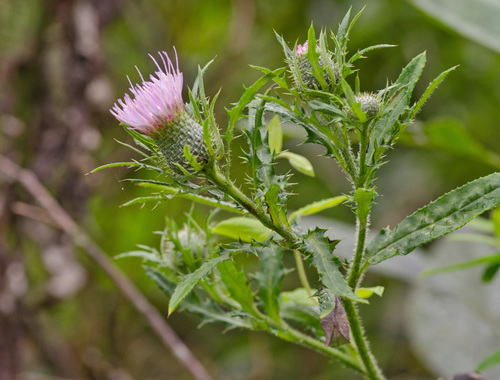
Cirsium altissimum (L.) Spreng. is, as its scientific name suggests, a tall herb. In sunny locations it can reach up to 400 cm (13 ft) in height, while shaded individuals grow to around 150 cm (5 ft). It is a biennial or perennial plant that blooms only once before dying. In its first year, it grows as a slightly hairy leaf rosette with small spines along the leaf edges. This rosette can reach up to about 30 cm (1 ft) across. The plant produces a long, slender taproot that measures 15 cm (6 in) or longer. In its second year, the plant produces a new leaf rosette with longer hairs and stout spines. In addition to the taproot formed the previous year, it now also grows shallow, sinewy radiating roots. Second-year plants grow tall, tough stems that are densely covered in stiff hairs. Large plants develop some branches along the upper section of their stems. Stem leaves are arranged alternately, and can grow up to 23 cm (9 in) long and 8 cm (3 in) wide. Leaf shape varies: larger leaves are generally lanceolate, while smaller leaves are elliptic. Leaves range from uncut to deeply pinnately lobed, and this variation occurs between different plants and even on the same individual plant. A spine is typically present at the pointed tip of each lobe or dentate tooth. The upper surface of leaves has flattened white hairs, and the lower surface has a dense mat of white-woolly hairs. Leaves are either sessile or slightly clasp the stem. Plants sometimes only have one flower head, but more often produce multiple. Flower heads contain pink or purple (rarely white) disc florets and have no ray florets, and can grow up to 5 cm (2 in) across. The native range of C. altissimum in the United States extends west from Massachusetts to North Dakota, and south from there to Texas and the Florida Panhandle. This species grows in prairies, open woodlands, and disturbed sites. Its flowering period runs from June to October. It is an important source of nectar for many species of bees, butterflies, and moths, and acts as a larval host for the swamp metalmark (Calephelis muticum) and painted lady (Vanessa cardui) butterflies. Many bird species, including the American goldfinch, feed on its seeds.