About Chroicocephalus philadelphia (Ord, 1815)
Species Size Comparison
Bonaparte's gull (Chroicocephalus philadelphia) is one of the smallest gull species; only the little gull and Saunders's gull are smaller.
Adult Measurements
Adult Bonaparte's gulls measure 28 to 38 cm (11 to 15 in) in body length, have a wingspan of 76–84 cm (30–33 in), and weigh 180–225 g (6.3–7.9 oz). Males and females share identical plumage and bare part coloration, though males are typically heavier than females.
Body Proportions
Compared to other common hooded gulls of North America, Bonaparte's gull has a smaller body, smaller head, and smaller bill.
Adult Body Plumage
Adult Bonaparte's gulls have grey upperparts and white underparts; unlike other gulls in the genus Chroicocephalus, the grey colour extends up the back of the neck to just below the head.
Adult Wing Markings
The upper surfaces of their wingtips are marked with black and white stripes: the outermost four primary feathers are white with black tips, while the remaining primary feathers are grey with black tips. The entire undersurface of the wing is very pale.
Breeding Plumage Hood
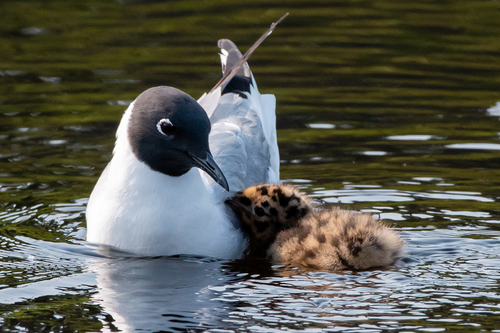
In breeding plumage, adults have a slaty black hood, which is lost in non-breeding plumage.
Bare Part Coloration
Their short, thin bill is black, and their legs are pinkish-red in winter and orangish-red in summer.
Juvenile Plumage
Juvenile plumage, which is usually only seen on breeding grounds, has scalloped brown patterning on the back and patchy brown patterning on the head. Juveniles moult into first-winter plumage in August, mostly before migrating south.
First-Year Plumage
First-year birds have a grey back similar to adults, but retain a brown bar across the forewing, blackish tips on the secondary feathers, and a black tip on the tail. Their plumage stays the same through their first winter and the following summer, though summer plumage fades and becomes paler from wear.
First Summer Hood Development
Fewer than 5 percent of Bonaparte's gulls develop a dark hood in their first summer, and any hood that does appear is duller than the hood of breeding adults.
Two-Year-Old Plumage
Most two-year-old Bonaparte's gulls grow full adult plumage, but a small number keep immature markings such as brown spots on the forewing and dark tips on some tail feathers.
Similar Species Confusion
The species most easily confused with Bonaparte's gull is the Old World black-headed gull. Each species is a regular but uncommon or rare winter visitor within the other species' wintering range.
Black-Headed Gull Distinction
Bonaparte's gull can be told apart from black-headed gull by its smaller size, slenderer darker bill, pale grey back of the neck, and pinker legs; in flight, Bonaparte's gull also has a noticeably whiter underwing, lacking the dark underside to the primary feathers that black-headed gull has.
Immature Little Gull Comparison
Immature little gulls can also be confused with immature Bonaparte's gulls; little gull is even smaller than Bonaparte's gull, and the forewing bar on year-old little gulls is black, not dark brown.
Adult Little Gull Comparison
Adult little gulls, which have uniform pale grey upperwings and blackish underwings, are far less likely to be confused with Bonaparte's gull.
Breeding Range
Bonaparte's gull breeds in boreal forest across southern Alaska and most of interior western Canada, extending east as far as central Quebec and south to within 320 km (200 mi) of the Canada–United States border.
Breeding Habitat Preference
It avoids dense stands of conifers, and instead favours more open areas such as the treed edges of bogs, fens, marshes, ponds, or islands. It typically nests within 60 m (200 ft) of open water.
Wintering Range
It winters along the coasts of North America and in the Great Lakes.