About Chroicocephalus brunnicephalus (Jerdon, 1840)
Species Classification & Nomenclature
The brown-headed gull, Chroicocephalus brunnicephalus, is a small gull that breeds on the high plateaus of central Asia, ranging from Tajikistan to Ordos in Inner Mongolia. It is a migratory species, and spends the winter on coasts and large inland lakes of the Indian subcontinent.
Genus Classification History
Like many other gull species, brown-headed gulls were traditionally classified in the genus Larus.
Breeding Habitat & Nesting
Brown-headed gulls breed in colonies, nesting on the ground in large reedbeds, marshes, or on lake islands.
Winter Social Behavior
Like most gulls, they are highly gregarious during winter, both while feeding and at evening roosts.
Marine Habitat Association
They are not a pelagic species, and are rarely seen out at sea far from coasts.
Feeding Habits
They are bold, opportunistic feeders, and will readily scavenge for food in towns or feed on invertebrates in ploughed fields.
Size Comparison
The brown-headed gull is slightly larger than the black-headed gull.
Summer Adult Plumage
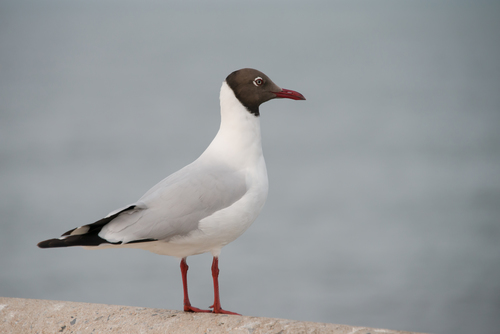
Summer adult brown-headed gulls have a pale brown head that is lighter in color than the black-headed gull’s head, a pale grey body, and red bill and legs. The black tips of their primary wing feathers have noticeable white "mirrors". Their underwing is grey, with black flight feathers.
Winter Adult Plumage
Adults lose their brown hood in winter, leaving only dark vertical streaks on the head.
Maturation Timeline
Brown-headed gulls take two years to reach full maturity.
First-Year Bird Plumage
First-year birds have a black terminal band on their tail, more dark areas on their wings, and a less uniform hood in summer.
Vocalization Trait
This species is very noisy, particularly when at breeding colonies.