About Chloropyron palmatum (Ferris) Tank & J.M.Egger
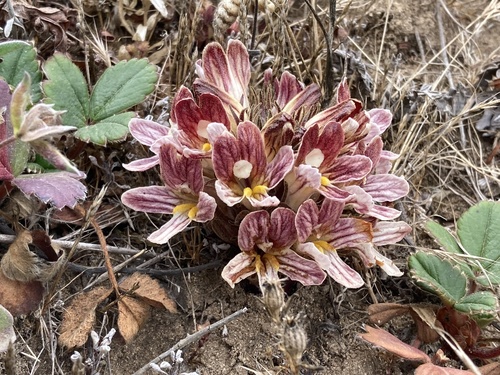
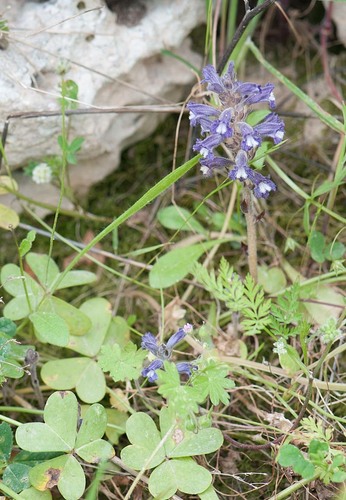
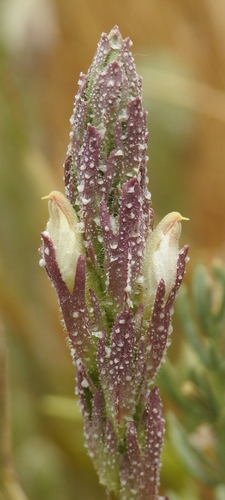
Chloropyron palmatum is an annual herb that grows 10 to 30 centimeters tall. The plant is glandular, covered in short hairs, and often encrusted with salt crystals it has excreted. Its sparse leaves are oblong, gray-green, and up to 18 millimeters long; most are usually irregularly toothed, while lower leaves can be entire. The bracts subtending flowers are lobed along the margin. Each individual flower is subtended by a single palmate bract that is 12 to 18 millimeters long, pale lavender, and deeply divided into 2 to 3 pairs of lobes, with the middle lobe longer than the others, giving the species its name palmatum. The inflorescence is a dense columnar spike of flowers up to 15 centimeters long. Each flower is up to 2 centimeters long, with a fuzzy white pouch that is sometimes tinted purple, enclosed in darker sepals. This plant is endemic to the Central Valley of California. It has been recorded in Colusa, Yolo, Alameda, San Joaquin, Madera, and Fresno Counties, introduced to Glenn County, and extirpated from San Joaquin County. One source states the species is currently known from 21 locations in seven metapopulations, while the California Native Plant Society records 14 locations: Kerman*, Tranquillity, Firebaugh*, Poso Farm, Altamont, Livermore, Stockton West*, Grays Bend, Grimes*, Colusa, Arbuckle, Logandale, Maxwell, and Moulton Weir. Across these areas there are 25 subpopulations: 17 are extant, 5 are possibly extirpated, and 3 are presumably extirpated. Asterisks mark locations with possibly or presumably extirpated populations. The species may still be present in some recorded extirpated areas, and can return from a seed bank when conditions are favorable. Chloropyron palmatum has likely always been naturally rare, as it occurs in the rare habitat type of alkali sink. It is limited to seasonally flooded flats with saline and alkaline soils, where it grows with other halophytes including iodine bush (Allenrolfea occidentalis) and alkali heath (Frankenia salina). It is a hemiparasite, grows at altitudes from 5 to 155 meters, and flowers from May to October.