About Chloanthes stoechadis R.Br.
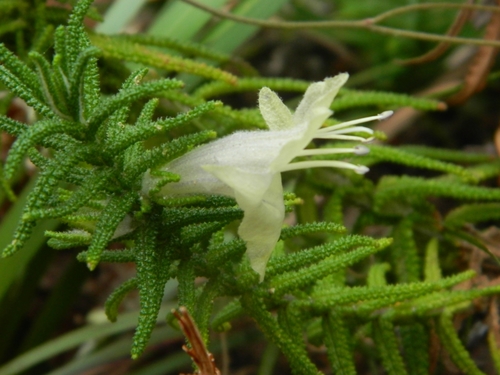
Chloanthes stoechadis, formally Chloanthes stoechadis R.Br., is a small, branched undershrub that typically reaches 30–90 cm (12–35 in) in height, with stems covered in a white woolly layer. Its leaves are arranged oppositely and are roughly linear in shape, usually between 0.5–5 cm (0.20–1.97 in) long. They are dull green, with a roughly wrinkled texture on the upper surface, a white woolly texture on the lower surface, and rolled-under margins. Flowers are borne singly in the upper leaf axils, with corollas that are yellowish green or greenish blue. The corolla is tubular, up to 4 cm (1.6 in) long, and is mostly hairy on the inside. The flower stalk (pedicel) is 1–4 mm (0.039–0.157 in) long, or nearly absent. The lower lobe of the corolla is longer, measuring 6–13 mm (0.24–0.51 in) long and 3.5–8 mm (0.14–0.31 in) wide at its base. Both the style, which measures 18–45 mm (0.71–1.77 in) long, and the stamens extend beyond the floral tube. The calyx lobes are narrowly oval in shape, have a blistered texture, and have curved or rolled-under margins. The bracts are leaf-like, sessile, and range from linear to lance-shaped. They measure 8–17 mm (0.31–0.67 in) long and 1.5–3 mm (0.06–0.12 in) wide, have a wrinkled, blistered upper surface, a woolly lower surface, and are somewhat rough due to short, hard protrusions. Flowering typically occurs from July to October, and is followed by the production of a dry, hemispherical fruit. This species most commonly grows near rocky outcrops on poor sandy soils in woodland, sclerophyll forest, and heath habitats north of Jervis Bay in New South Wales. It occurs as a rare species in Western Australia, and can also be found in scattered locations across Queensland.