About Chionanthus ramiflorus Roxb.
Scientific Name and Growth Form
Chionanthus ramiflorus Roxb. is an evergreen shrub or tree that can grow up to 23 meters (75 feet) tall.
Trunk and Twig Characteristics
Its trunk and branches are pale, and leafy twigs are circular in cross-section.
Leaf Shape and Size
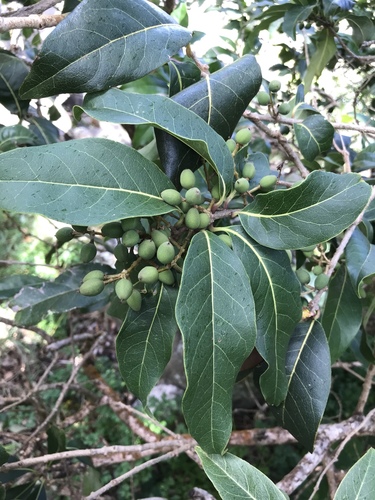
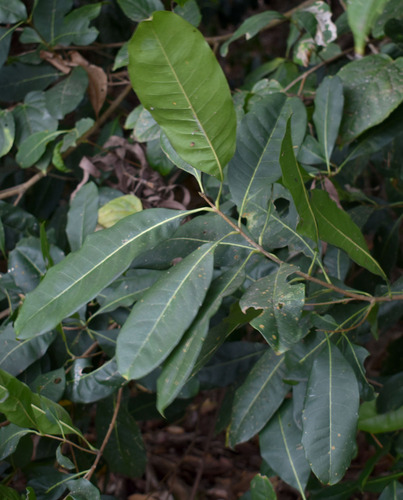
The glossy green leaves are typically elliptic to oblong-elliptic, measuring 8 to 20 cm (3.1 to 7.9 in) long and 4 to 7 cm (1.6 to 2.8 in) wide.
Petiole and Leaf Veins
Leaves attach to twigs via a petiole that can reach up to 5 cm (2.0 in) long, and have 7–10 lateral veins on each side of the midrib.
Inflorescence Traits
The inflorescence is a panicle growing up to 12 cm (4.7 in) long, holding numerous small white or yellow flowers.
Flower Structure
Each flower has four petals that are about 2.5 mm (0.10 in) long.
Fruit Characteristics
The fruit is a blue-black, ovoid drupe around 25 mm (1.0 in) long and 15 mm (0.6 in) in diameter.
Native Distribution
This species is native to regions matching the World Geographical Scheme for Recording Plant Distributions: South-Central China, Southeast China, Hainan, Taiwan (Eastern Asia); Assam, Bangladesh, East Himalaya, India, Nepal, Sri Lanka, West Himalaya (Indian Subcontinent); Andaman Islands, Cambodia, Laos, Myanmar, Nicobar Islands, Thailand, Vietnam (Indo-China); Borneo, Lesser Sunda Islands, Malaya, Maluku, Philippines, Sulawesi, Sumatera (Malesia); New Guinea, Solomon Islands (Papuasia); and Queensland, Australia.
Habitat Types
It grows in evergreen or deciduous forests, including rainforest, monsoon forest, and littoral forest.
Altitudinal Range
Recorded altitudes for the species vary by location: from sea level up to around 600 m (2,000 ft) in Australia, up to 1,500 m (4,900 ft) in Thailand, up to 2,000 m (6,600 ft) in China, and between 400 and 500 m (1,300 and 1,600 ft) in Nepal.
Fruit Predation
Ecologically, this plant's fruit is eaten by cassowaries, figbirds, koels, Torres Strait pigeons, and golden bowerbirds.
Leaf Predation
Its leaves are eaten by Lumholtz's tree-kangaroos.