About Chilopsis linearis (Cav.) Sweet
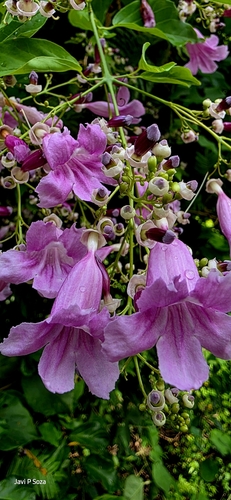
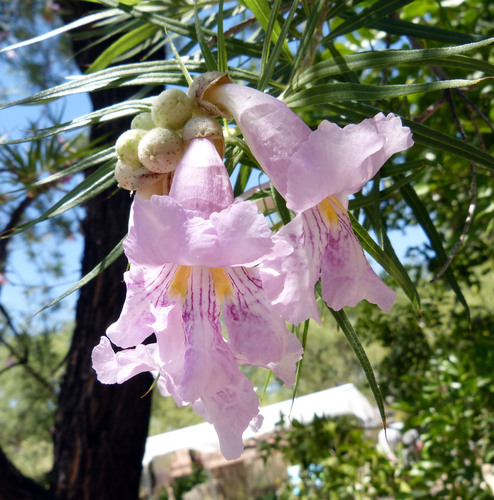
Chilopsis linearis (Cav.) Sweet is a species that grows as a shrub or small tree, reaching up to 9 meters (29 1/2 feet) in height. Its leaves are deciduous, linear and curved, growing up to 30 centimeters (12 inches) long and just a few millimeters wide. Blooming occurs from April through September, with flowers borne in terminal panicles or racemes. Around two to four flowers are open at once per inflorescence. The calyx measures 8–14 mm (3/8–1/2 inch), is slightly inflated, and occurs in varying shades of purple. The corolla measures 2–5 cm (3/4–2 inches), and ranges in color from lavender to light pink. The throat and lower lip of the corolla have a pattern of yellow ridges and purple lines, and the corolla margins are crinkled. Its fruit is a linear pod up to 30 cm (12 inches) long, which holds numerous winged seeds. There are two recognized subspecies: Chilopsis linearis subsp. linearis, which occurs in Utah, Arizona, New Mexico, western Texas, and Mexico; and Chilopsis linearis subsp. arcuata, which occurs in Nevada, California, and Baja California. This species is a phreatophyte, well adapted to ephemeral desert washes and sandy streams. It is distributed across much of the southwestern United States and northern Mexico, and most often grows below 1,500 m (5,000 ft) in elevation. Chilopsis linearis is primarily pollinated by large bees in the family Apidae, including carpenter bees, bumblebees, Anthophora, and Centris. Hummingbirds also frequently visit its flowers. The species is cultivated for its large, showy flowers, and its ability to tolerate hot, dry climates. While naturally growing with a very irregular shape, it can be easily pruned to form a conventional tree shape. A number of cultivars have been selected for cultivation; some, such as 'Rio Salado', produce dark purple or magenta flowers. Chilopsis linearis can survive temperatures as low as 10 degrees F (-12 °C). It is closely related to the genus Catalpa, and hybrids can be produced between the two genera. The intergeneric hybrid between Chilopsis linearis and Catalpa bignonioides is named × Chitalpa tashkentensis, which originated in a botanic garden in Tashkent, Uzbekistan. Parts of this plant have been used in traditional medicine. It has been used to treat fungal infections including candidiasis and athlete's foot, as well as wounds and cough. Its wood has been used to make bows and baskets.