About Chelidonichthys obscurus (Walbaum, 1792)
Taxonomic Naming
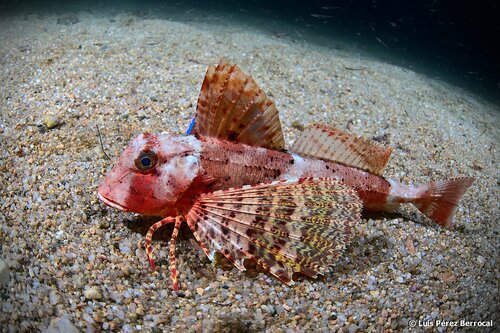
This species, the longfin gurnard, Chelidonichthys obscurus (Walbaum, 1792), has a large head armored by large bony plates marked with many ridges and spines, and it lacks an occipital groove.
Dorsal Fin Structure
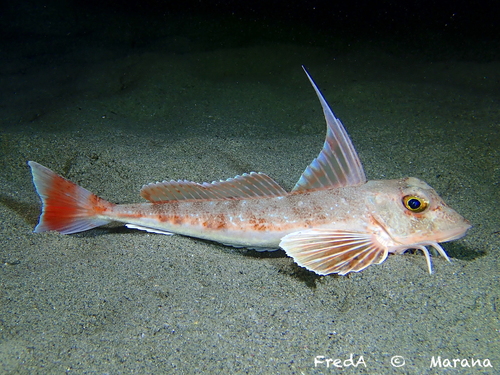
It has two separate dorsal fins: the first dorsal fin holds 10 or 11 spines, while the second holds 17 to 19 soft rays.
Anal Fin Structure
Its anal fin has 17 or 18 soft rays.
Pectoral Fin Structure
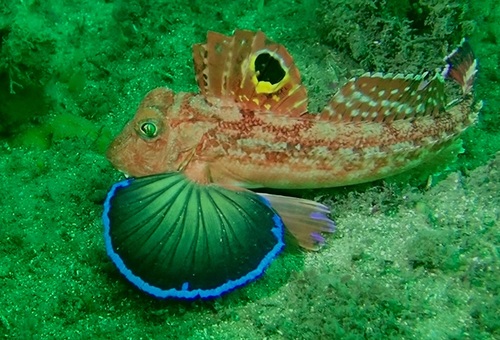
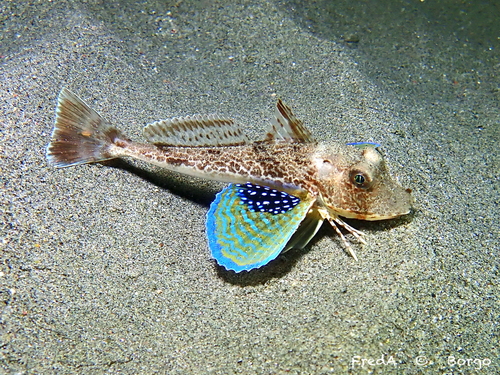
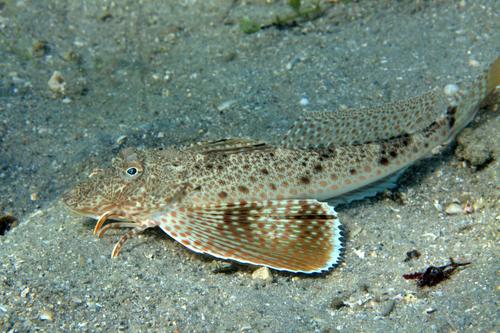
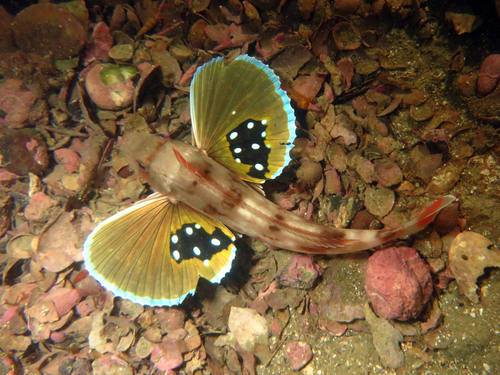
The first spine of the first dorsal fin is elongated, and three pectoral fin rays are separate from the main fin.
Lateral Line Scales
The scales along its lateral line are plate-shaped.
Body Coloration
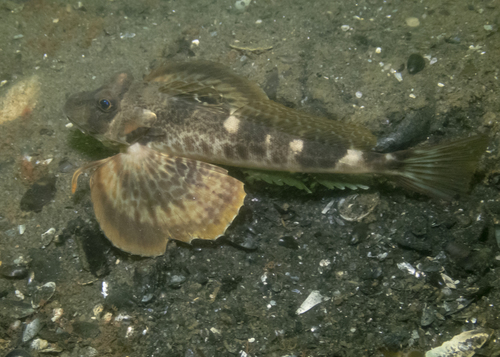
Its upper body is reddish pink, its flanks are iridescent, and its lower body is pale.
Fin Coloration
The pectoral fins are dark blue, and all other fins are yellowish.
Maximum Recorded Length
The maximum published total length recorded for this species is 50.5 cm (19.9 in).
General Distribution Range
The longfin gurnard occurs in the Eastern Atlantic Ocean and the Mediterranean Sea.
Atlantic Distribution Details
It is rare off the coasts of southern England and Ireland, and its range extends south from this area to Mauritania, including the Canary Islands, the Azores, and Madeira.
Mediterranean Distribution Details
It is present across most of the Mediterranean, but it is very rare off the coast of Turkey and absent from the far eastern part of the sea.
Absence from Black Sea
It does not live in the Black Sea.
Habitat Type
This is a demersal, benthic fish that inhabits the continental shelf, where it lives on soft substrates and among fallen rocks.
Depth Range
It can be found at depths ranging from 20 to 170 m (66 to 558 ft).