About Chelidonichthys lastoviza (Bonnaterre, 1788)
Head Morphology
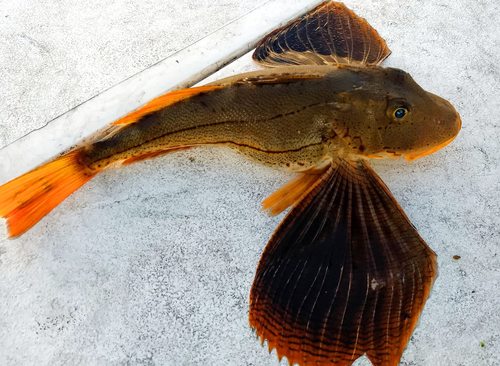
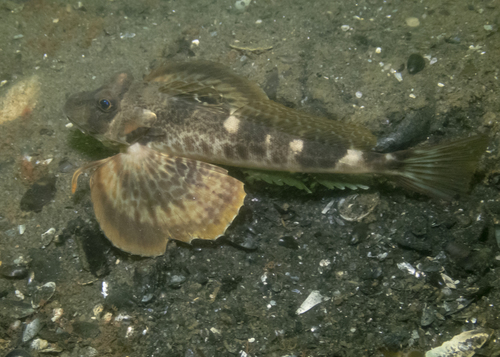
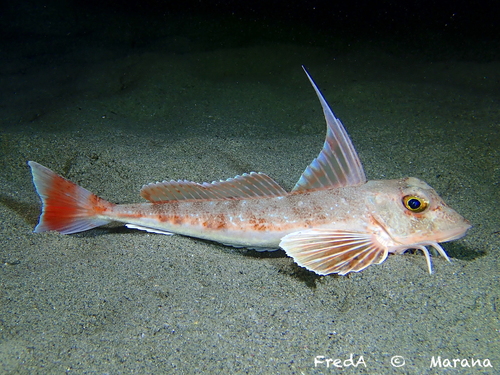
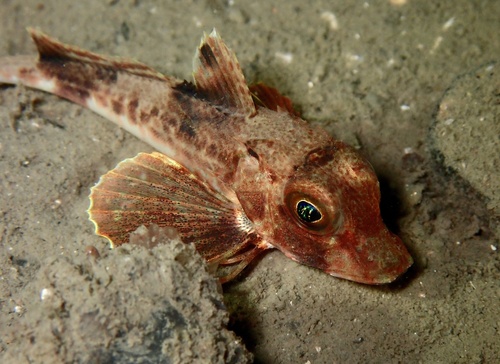
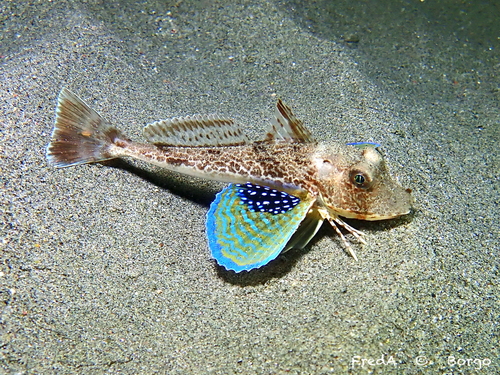
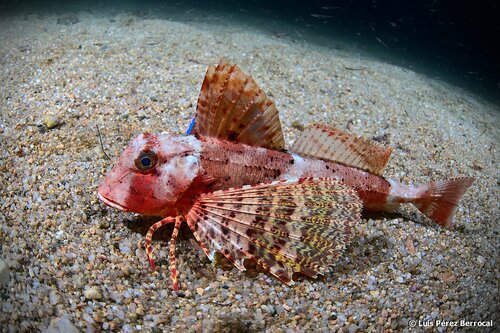
The streaked gurnard, Chelidonichthys lastoviza, has a large triangular bony head marked by many ridges and spines, with a deep occipital groove and an almost vertical snout profile.
Dorsal and Anal Fins
It has two separate dorsal fins: the first holds between 9 and 11 spines, while the second dorsal fin and the anal fin each have between 14 and 17 fin rays.
Body Ridges and Scalation
Its body is covered in distinct oblique skin ridges that originate at the lateral line. The breast of this fish may or may not have scales, but the belly is always scaled.
Lateral Line Scales
The scales along its lateral line are enlarged and bear small spines.
Body Coloration
The upper body is red, with dark spotting across the head and back, while the lower body is paler.
Pectoral Fin Features
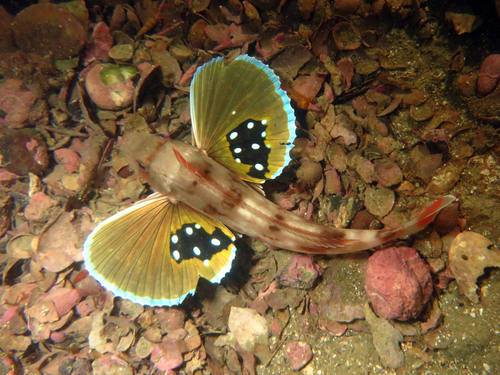
Its pectoral fins are greyish, marked with large dark blue spots, and the three lowest pectoral fin rays are separated from the rest of the fin.
Size
The maximum published total length for this species is 40 cm (16 in), with 15 cm (5.9 in) being a more typical size.
Atlantic Distribution
The streaked gurnard occurs in the eastern Atlantic Ocean, ranging from southern Norway and Scotland south to the Cape of Good Hope, and along the South African coast into the southwestern Indian Ocean as far north as Mozambique.
Additional Range
It can also be found around the Macaronesian Islands and the islands of the Gulf of Guinea, as well as throughout the Mediterranean Sea, though it is not present in the Black Sea.
Habitat and Depth
This is a demersal species that lives on rocky and sandy substrates, found from shallow coastal waters down to depths of 150 m (490 ft).