About Chasmodes saburrae Jordan & Gilbert, 1882
Size
The Florida blenny, Chasmodes saburrae, is a small fish that reaches a maximum total length of 10 cm (4 in), with a more common typical length of 6 cm (2.4 in).
Fin Structure
It has one continuous dorsal fin that has approximately six spines and nineteen soft rays, while its anal fin has eighteen or nineteen rays.
Coloration
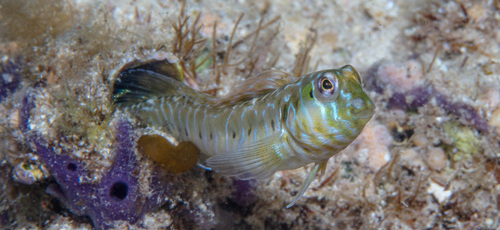
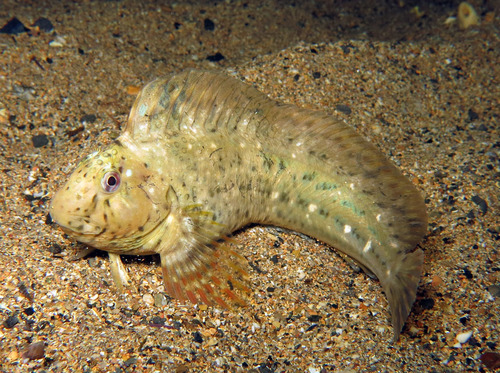
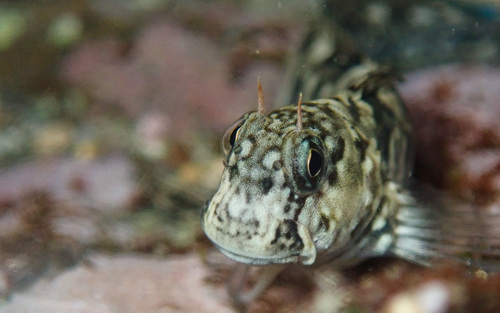
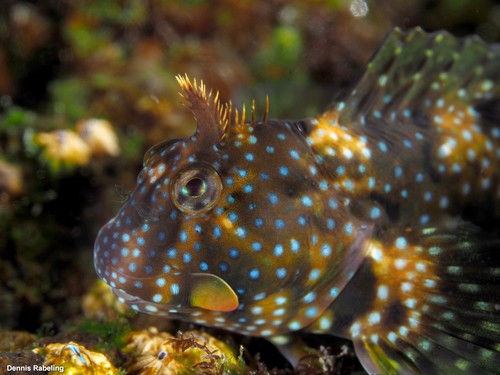
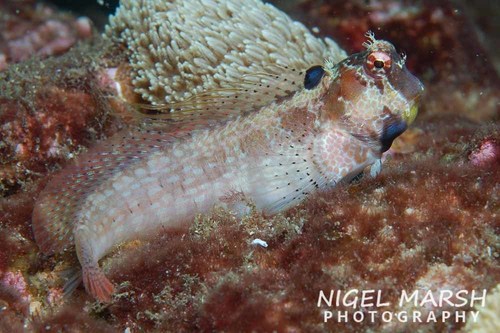
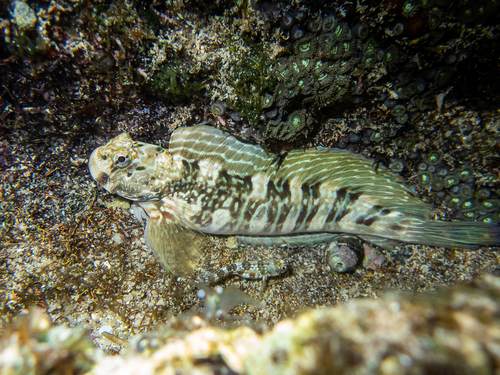
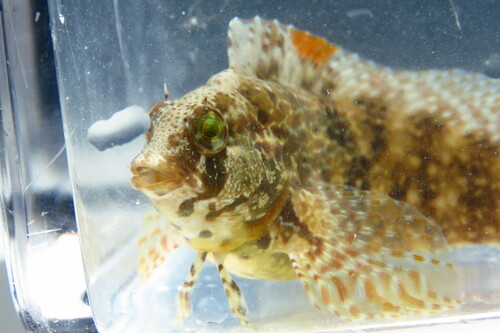
This species has mottled or speckled brown coloration.
Sexual Dimorphism
Males and females differ in form: the female's first anal spine is reduced in size.
Breeding Male Morphology
During the breeding season, territorial males develop enlarged anal spines paired with associated fleshy lobes and longitudinal skin folds.
Breeding males also grow larger than females, have pale longitudinal markings, an iridescent blue spot at the front of the dorsal fin, an orange streak extending backward from the blue spot, and orange coloring on the gills and throat.
Depth Range
This blenny is native to shallow waters less than 6 m (20 ft) deep, found off the southeastern United States and in the northeastern Gulf of Mexico.
Geographic Range
Its range stretches from New Smyrna Beach, Florida along the coast to the Chandeleur Islands of Louisiana, and includes the Indian River Lagoon, the Florida Keys and the Mississippi Delta.
Habitat
It is a demersal fish, and is most frequently found around mangroves and over rocky reefs.
Diet Variation By Size
Florida blennies are omnivorous, and their diet changes based on their size.
All size classes of Florida blenny feed on copepods, but smaller individuals mostly hunt for prey in mid-water.
Larger blennies typically feed on or near the seabed, and add detritus, plant material, polychaete worms, molluscs, shrimp, other crustaceans, and fish eggs to their diet.
Predation
Florida blennies are likely preyed on by other fish and large invertebrates.
Social Behavior
This species does not form shoals, and males become territorial during the breeding season, which runs from approximately March to October.
Mating System
A single male will mate with multiple females, all of which deposit their eggs in the same chosen location.
Nesting Sites
Common nesting sites include empty shells of the eastern oyster (Crassostrea virginica) and rigid pen shell (Atrina rigida), rock crevices, sponges, and discarded cans; one discarded can was recorded holding 11,000 Florida blenny eggs.
Egg Care
The male guards the eggs for around three weeks until they hatch, while females produce additional batches of eggs at intervals through the breeding season.
Larval Development
The newly hatched larvae are pelagic and feed on zooplankton, before settling to the seabed after approximately three weeks when they measure 6 mm (0.24 in) long.