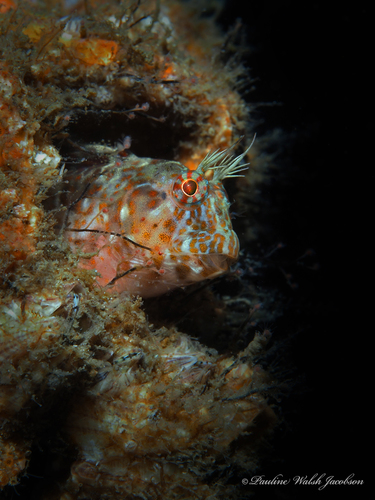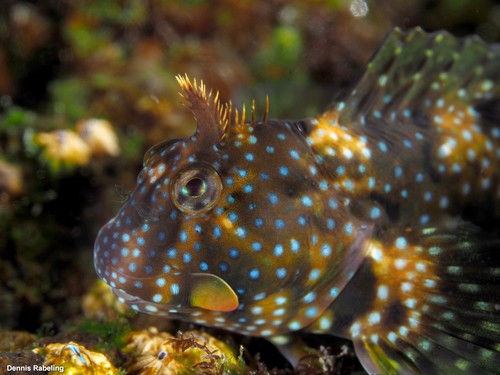
About Coryphoblennius galerita (Linnaeus, 1758)
Species Identification
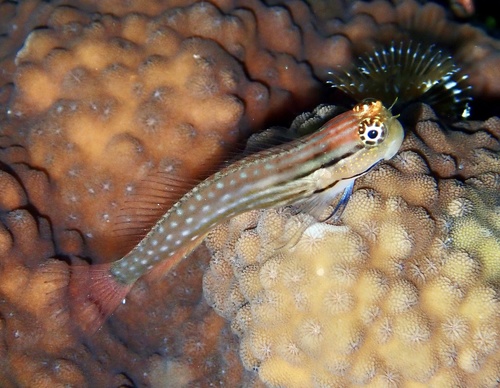
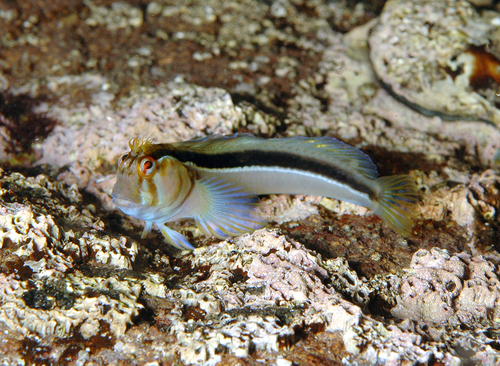
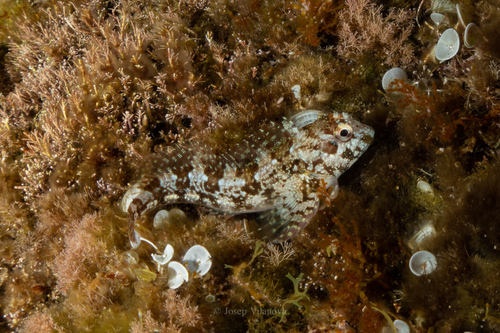
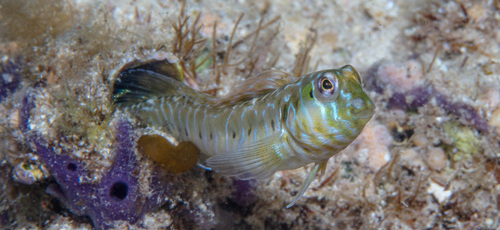
Montagu's blenny, Coryphoblennius galerita, is a small scaleless fish with an elongated body. Its eyes are positioned on top of the head, and its mouth points downward.
Maximum Size
This species reaches a maximum total length of 8.5 centimetres (3.3 in).
Base Coloration
Its base body colour is pale brown, marked with olive-green vertical stripes and light blue spots.
Dorsal Fin Structure
It has a single dorsal fin that runs the full length of its body, with a clear notch partway along.
Head Crest Feature
A fringed, fleshy crest sits between its eyes; in Britain and Ireland, this feature separates Montagu's blenny from other local blenny species. This fleshy crest continues along the fish's dorsal surface as a line of short fleshy tentacles.
Pectoral Fin Function
It has large pectoral fins that resemble limbs, which it uses to grip onto rock surfaces.
Geographic Color Variation
Atlantic specimens of Montagu's blenny often have more dark spots than individuals from Mediterranean populations.
Spawning Male Traits
When spawning, males become uniformly dark or develop a marbled pattern, and grow a white upper lip.
General Distribution
Montagu's blenny is distributed in the northeastern Atlantic Ocean and the Mediterranean Sea.
Atlantic Range
In the Atlantic, its range stretches from southern Ireland and the southern coasts of Great Britain south to Portugal, and along the West African coast as far as Guinea. It also lives in the Macaronesian archipelagos of Madeira, the Azores, and the Canary Islands.
Mediterranean and Black Sea Range
It can be found along all Mediterranean coastlines, extending into the Sea of Marmara and the western Black Sea. It has been recorded off the central Turkish Black Sea coast, and its potential presence in the eastern Black Sea remains unconfirmed.
Habitat Type
This species inhabits intertidal rocky coasts around the mid-tide level, and is often found on steep rocky surfaces up to the surf zone.
Rock Pool Preference
It prefers rock pools that are not overgrown by leafy seaweeds, and is most commonly found in pools dominated by coralline algae.
Air Breathing Ability
At low tide, Montagu's blenny can stay out of water sheltering under rocks and seaweeds, as it is capable of breathing air.
Juvenile Habitat
Juveniles are frequently found in tidal pools, and sometimes shelter inside empty barnacle shells.
Diet Type
Montagu's blenny is omnivorous.
Diet Composition
Its main food source is small invertebrates, including acorn barnacles, while algae make up an important part of the adult diet, scraped off rock substrates.
Activity Pattern
It is primarily active during the day, especially at high tide, and at night it may sleep up to 40 centimetres (16 in) above the water's surface.
Breeding Season
Breeding occurs in summer, between May and August, in shallow sometimes intertidal water.
Male Courtship Behavior
Males perform a courtship display where they rock their heads from side to side.
Egg Characteristics
The eggs are demersal, and stick to the substrate via an adhesive filament.
Male Territorial Guarding
Males guard territories that contain depressions, crevices, or holes created by piddocks. A male will guard egg masses laid by multiple different females.
Nest Care Behavior
He periodically fertilizes eggs in the nest by releasing sperm during quivers, in a pattern similar to other blennies, and he fans the eggs to aerate and clean them.
Larval Traits
The larvae are planktonic, and are most often found in shallow coastal waters.