About Chamaeleon gummifer (L.) Cass.
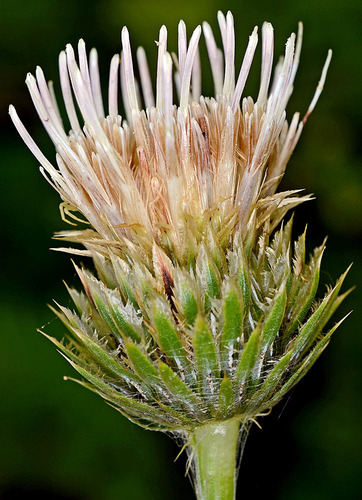
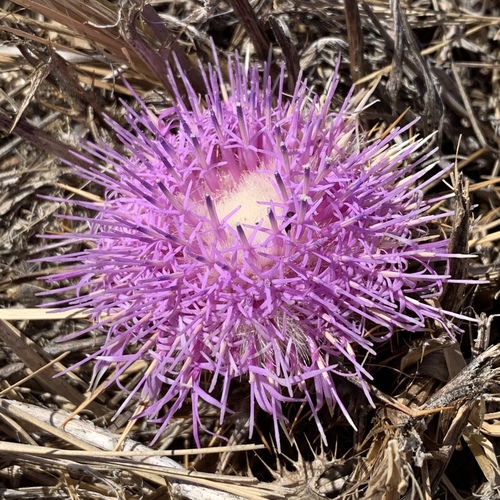
Chamaeleon gummifer (L.) Cass. is a perennial thistle. It has a long rhizome that can reach up to 40 cm in length, with spiky leaves growing from its center. A pinkish inflorescence grows at the plant's center; this inflorescence forms a capitulum made up of many small threadlike flowers, and is surrounded by spiny bracts. Unlike most other thistles, the inflorescence of this species does not grow on a stem. When its fruit is ripe, it may ooze a white or yellowish gummy latex produced by the rhizome. This species flowers in late summer or early autumn. Chamaeleon gummifer occurs throughout the Mediterranean basin, including Northern Africa, the Iberian Peninsula, Italy, Greece, and Malta. It grows in a range of habitats and on a variety of substrates, including cultivated and uncultivated fields, shrublands, forests, and rocklands. It is currently rated as Least Concern on the IUCN Red List. The toxicity of Chamaeleon gummifer is attributed to two related glycosides: atractyloside and carboxyatractyloside. In Morocco, this plant is a common cause of plant poisoning, and children are especially likely to experience severe poisoning effects. Accidental ingestion most often happens because the plant is confused with the artichoke thistle, or because people use its gummy discharge as a chewing gum. Fatal poisoning cases are not uncommon, even when patients receive symptomatic treatment. Between 1981 and 2004, at least 98 deaths from Chamaeleon gummifer poisoning were recorded in Morocco, most of which were children under the age of 16. Severe poisoning cases are often associated with liver and kidney failure, and there is currently no specific treatment for poisoning from this plant.