About Chamaeleo zeylanicus Laurenti, 1768
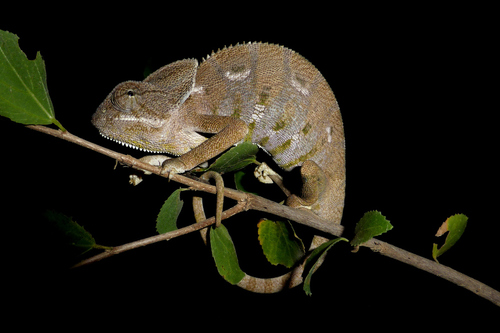
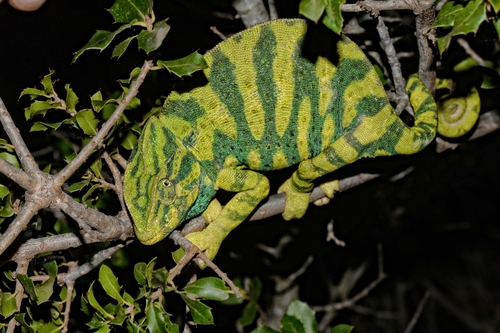
Chamaeleo zeylanicus Laurenti, 1768 has a bony casque on its head, ornamented with crests or tubercles. An interorbital septum, the separation between the eyes, is present.
Dentition Traits
This species has acrodont dentition; its teeth are compressed, triangular, and more or less distinctly tricuspid, and the palate is toothless.
Eye Features
The eyes are large, covered by a thick, granular lid pierced with a small central opening for the pupil. No tympanum or external ear is present.
Body and Skeletal Structure
The body is compressed, and the neck is very short. The vertebrae are procoelian, and abdominal ribs are present.
Limb and Digit Arrangement
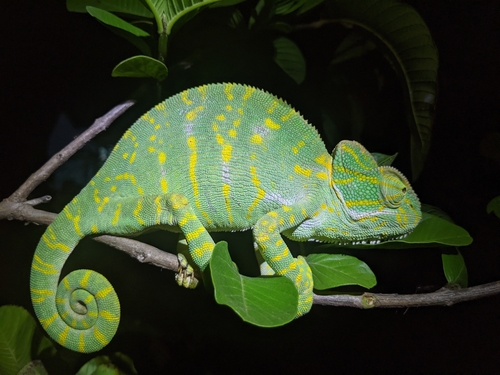
The limbs are long, and hold the body raised off the ground. Digits are arranged in bundles of two and three digits; on the hand, the inner bundle is formed of three digits, and the outer bundle of two digits, which is reversed on the foot.
Skin and Tail Traits
The tail is prehensile. The head and body are covered with granules or tubercles.
Casque Morphology
The casque is much elevated toward the posterior, with a strong curved parietal crest. The distance between the mouth commissure and the end of the casque equals, or nearly equals, the distance between the tip of the snout and the rear extremity of the mandible.
Head Crest and Lobe Features
No rostral appendages are present. A strong lateral crest is present, which does not reach the end of the parietal crest. An indication of a dermal occipital lobe is found on each side, which also does not reach the parietal crest.
Body and Ventral Crests
No enlarged tubercles occur on the body. A feebly serrated dorsal crest is present, and a series of conical tubercles forms a very distinct crest along the throat and belly.
Sexual Dimorphism
Males have a tarsal process or spur, and their tail is longer than the combined length of the head and body. The gular-ventral crest and the commissure of the mouth are white.
Size Measurements
Maximum snout-to-vent length is 7 inches, with a prehensile tail that reaches 8 inches.
Species Distribution
This species is distributed across most of India south of the Ganga river, southeasternmost Pakistan, and parts of Sri Lanka. This range leaves it widely geographically separated from all other chameleons, which live in Africa, Indian Ocean islands near Africa, southern Europe, and the Arabian Peninsula.
Distribution Origin
Phylogenetic evidence suggests this unusual distribution resulted from oceanic dispersal to India from Arabia during the mid-Miocene.
Type Locality
The type locality is Sri Lanka, a restriction made by Mertens in 1969.