About Chamaecrista fasciculata (Michx.) Greene
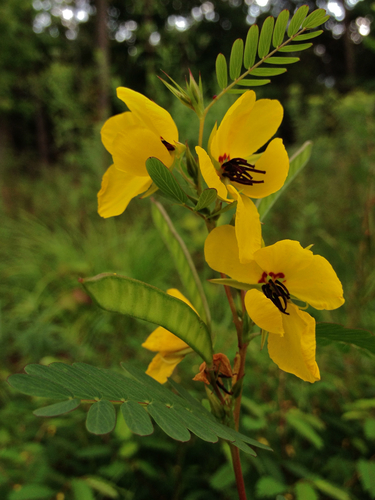
Chamaecrista fasciculata (Michx.) Greene, commonly called partridge pea, has leaves made up of 10 to 15 pairs of small, narrow leaflets that feel somewhat delicate to the touch. Like other legumes, this species shows nyctinasty, a circadian rhythmic nastic movement that makes its leaves open and close in response to day and night cycles. Its showy yellow flowers are roughly 1 inch (25 mm) across, and grow in clusters of 2 to 4 along the stem. Flowering typically occurs from July to September. Its fruit is a straight, narrow pod that measures 1.5 to 2.5 inches (38 to 64 mm) long; as the pod dries, it splits along two sutures, and the pod walls twist to expel seeds some distance away from the parent plant. This species is distributed across the eastern United States, excluding Vermont, Maine, and New Hampshire, and extends west as far as New Mexico, South Dakota, and Minnesota. Like other legumes, partridge pea is a nitrogen-fixing plant. Microorganisms live in its root nodules, creating a mutual relationship: the nodules give the microorganisms a safe habitat, and the microorganisms produce nitrogen compounds the plant needs to survive, giving the plant access to this key nutrient. Historically, the Cherokee tribe used partridge pea as a medicinal remedy for fainting spells, and also used it to prevent fatigue in ball players. The Seminole tribe used the plant to relieve nausea, and also used it as a bed for ripening persimmons. Partridge pea can be planted along roadways or streambanks to control erosion and improve soil fertility, because it establishes quickly, fixes nitrogen, reseeds itself, and naturally becomes less frequent once other plant species become established.