About Chaetodon interruptus Ahl, 1923
Species Nomenclature
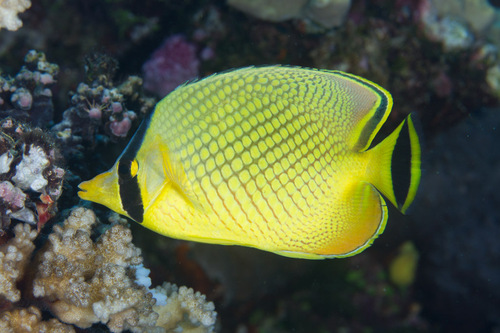
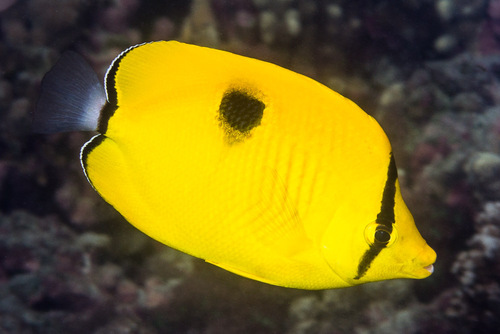
The yellow teardrop butterflyfish (Chaetodon interruptus Ahl, 1923) has a bright yellow, disc-shaped, laterally compressed body.
Body Markings
It has a large black spot on its upper flank, a black vertical bar through the eye, and a second black vertical bar at the rear margin that extends from the back of the soft-rayed section of the dorsal fin to the anal fin.
Tail Features
The tail is white, and the tail fin is transparent.
Flank Markings
Paler chevron-shaped markings run vertically down its flanks.
Juvenile Markings
Small juvenile fish have a white ring surrounding the black blotch on their flank; this blotch is rounder and less teardrop-shaped than the adult marking, and the black color has a blue tint.
Ontogenetic Marking Changes
As the fish grows, the outer white ring turns yellow, and the mark develops a teardrop shape.
Fin Ray Counts
This species has 12–13 spines and 21–23 soft rays in its dorsal fin, and 3 spines and 18–20 soft rays in its anal fin.
Maximum Size
It reaches a maximum total length of 20 centimetres (7.9 in).
Overall Distribution
This butterflyfish is distributed across the Indian Ocean.
Coastal Distribution
It occurs along the East African coast from Somalia and Socotra south to South Africa, and east as far as the coast of Sumatra and western Thailand.
Additional Range
Its range also includes most Indian Ocean islands and southern India.
Habitat
It inhabits a range of habitats from coral reef flats to deep slopes.
Adult Social Behavior
Adults are most commonly found in pairs, but will occasionally forage in small schools.
Reproduction
This is an oviparous species, where males and females form breeding pairs.
Diet
It is omnivorous with a varied diet that includes hard and soft coral fragments, sponges, polychaetes, and filamentous algae.