About Chaetodon bennetti Cuvier, 1831
Common and Scientific Name
This species is commonly known as the bluelashed butterflyfish, with the scientific name Chaetodon bennetti Cuvier, 1831.
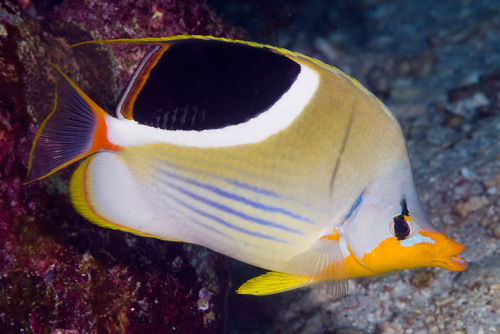
Body Base Color
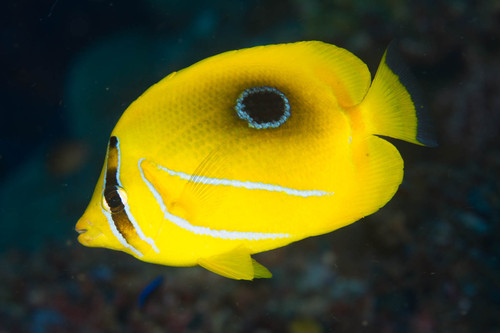
The bluelashed butterflyfish has a yellow body.
Body Markings
It has a black patch surrounded by a blue circle located below the dorsal fin, and two curved blue lines above its belly.
Eyestripe Features
Its vertical black eyestripe has blue lines on both flanking sides.
Fin Ray Count
The dorsal fin of this species contains 13 to 14 spines and 15 to 17 soft rays, while the anal fin has 3 spines and 14 to 16 soft rays.
Maximum Length
This species reaches a maximum total length of 20 centimetres, which equals 7.9 inches.
Overall Distribution Range
The bluelashed butterflyfish has a wide distribution across the Indo-Pacific region.
Eastern Indian Ocean Distribution
In the eastern Indian Ocean, it can be found along the eastern coast of Africa, ranging from Somalia to South Africa.
Indian and Western Pacific Range
It occurs across the Indian Ocean as far north as India and Sri Lanka, and extends into the Pacific Ocean.
Pacific Range Extent
In the Pacific, its range reaches as far north as Kashiwa-jima in southern Japan, as far south as Lord Howe Island, and as far east as Mangarava in French Polynesia.
Australian Indian Ocean Territories Distribution
In Australia, this species occurs at the Indian Ocean territories of the Cocos (Keeling) Islands and Christmas Island.
Western Australia Distribution
In Western Australia, it is found at the Rowley Shoals and Scott Reef.
Eastern Australia and Timor Sea Distribution
It can also be found at Ashmore Reef in the Timor Sea, and along the eastern Australian coast from the northern Great Barrier Reef in Queensland south to Moreton Bay.
Habitat Type
Bluelashed butterflyfish inhabit seaward and lagoon reefs in areas with abundant coral growth.
Juvenile Habitat
Juveniles of this species may be found in shallow Acropora thickets.
Adult Social Behavior
Adults typically occur in pairs.
Diet
This species feeds mainly on coral polyps.