About Cettia cetti (Temminck, 1820)
Body Length
Cetti's warbler (Cettia cetti) measures approximately 13–14 cm (5.1–5.5 in) from bill to tail.
Weight
Males weigh 15 g (0.53 oz), while females weigh 12 g (0.42 oz).
Head and Wing Features
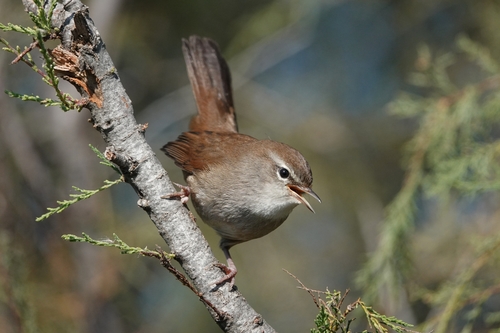
This species has a rounded head with a narrow pale grey stripe that arches over conspicuous black eyes, and short, rounded wings.
Plumage Coloration
Its upperparts are rich chestnut or dark reddish-brown, and its throat and breast are pale grey-brown.
Tail Characteristics
The tail is longer and broader than that of many other warblers.
Sexual Dimorphism in Plumage and Size
The sexes have similar plumage, but males are 26% to 32% heavier than females, and have a wing length 11.2% to 13% longer.
Wing Length Differences by Sex
A male Cetti's warbler has a wing longer than 60 mm, while a female's wing is shorter than 55 mm.
Age Identification by Plumage
Individuals can be aged by their plumage: juveniles look similar to adults, but have fresh plumage and two dark or dark grey spots on the tongue.
Tail Feather Count
Unlike most passerine birds, Cetti's warbler has ten tail feathers (rectrices) instead of the typical twelve.
Vocalization Traits
Cetti's warblers signal their presence with loud, distinct song that comes in bursts, and has a unique structure that prevents mating with other species.
Habitat Preferences
Cetti's warbler typically lives in thick shrubby vegetation in damp areas located close to, but not within, ponds, lakes, marshes and rivers.
European Population Trend Overview
Across Europe, the number of Cetti's warblers has increased greatly since 1990.
European Population Estimate
The current European population is estimated to be around 600,000 to 1,600,000 breeding pairs.
Regional Population Trends in Europe
Populations in Italy and Turkey are stable or increasing. The only deviation from this positive overall European population trend is in Greece, where the population decreased slightly between 1990 and 2000.
Conservation Status
Overall, Cetti's warbler is evaluated as secure.
UK Occurrence and First Breeding
The species was first recorded in the United Kingdom in 1961, with the first recorded breeding in 1972–73.
UK Population Fluctuations
Initial population growth was rapid, then the population fell by over a third between 1984 and 1986 after the severe 1985–86 winter, before rebounding rapidly again.
Recent UK Population Status
UK populations continue to grow; by 2016 there were 3,450 territorial males distributed across most of England and Wales, and the first breeding in Scotland was recorded in 2023.
Ireland Occurrence and Breeding
Cetti's warbler was first recorded in Ireland in 2013, with the first breeding recorded there in 2022.