About Cercis occidentalis Torr. ex A.Gray
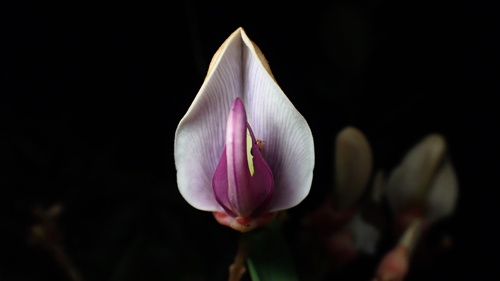
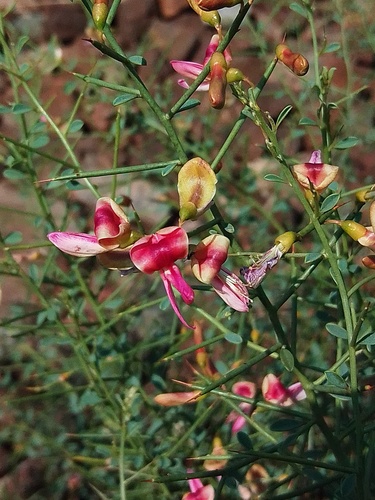
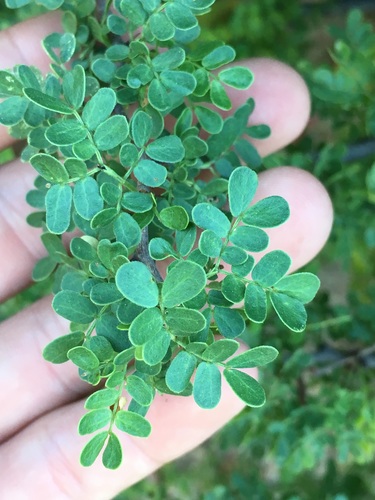
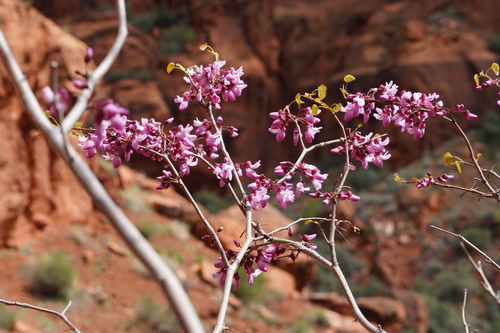
Cercis occidentalis, the western redbud, is a deciduous plant that grows as a shrub to small tree, reaching up to 7 metres (23 ft) tall. The largest known individual, located in Santa Rosa, grows to 8.8 metres (29 ft) high. It has a rounded crown on clustered, erect branches, with a total width of 3.0–6.1 metres (10–20 feet). Its branches are thin, shiny, and brown, while its twigs are slender, erect, and hairless. The leaves are arranged alternately along the twigs; they are simple, round, and slightly leathery, growing 5–9 centimetres (2.0–3.5 in) in diameter, attached by 12–25-millimetre (0.47–0.98 in) petioles. Leaves have heart-shaped bases, smooth entire margins, and 7 to 9 fan-like veins. The upper leaf surface is dark green, shiny, and hairless, while the lower surface is green and also hairless. New leaves emerge light green early in the growing season and darken as they mature; on plants growing at higher elevations, leaves may turn gold or red as cool weather arrives in autumn. It produces unbranched, showy inflorescences of bright pink or magenta flowers. The flowers, which resemble pea flowers, are about 12 millimetres (0.47 in) long and emerge before new leaves develop. They grow in clusters across the whole plant, making it very colorful and noticeable in the landscape. Its fruits are thin, dry legume pods, 4–7.5 centimetres (1.6–3.0 in) long and around 12 millimetres (0.47 in) wide, colored brown or reddish-purple. Clustered pods remain on the plant through the winter. This species is an abundant seeder, and its seeds have a high germination rate. Young plants tolerate shade, and mature plants tolerate light shade; its shade tolerance increases when soil moisture is higher. Its wood is fine-grained and dark yellowish brown, with a thin layer of whitish sapwood. Compared to the more commonly cultivated eastern redbud (Cercis canadensis), it has more rounded leaves and generally grows as a small shrub rather than a tree, though it often grows as larger trees up to 25 feet tall, especially in natural settings. Its native habitats include foothill woodlands and chaparrals, where it grows near stream banks on dry foothills and lower canyon slopes below 1,100 metres (3,600 ft). It grows frequently in rock crevices and soil pockets where seeds are well covered by mineral soil. Cercis occidentalis blooms in spring, from February to April. Like other legumes, it is a nitrogen-fixing plant; root nodules host symbiotic bacteria that produce nitrogen for the plant. It grows both singly and in shrubby clumps alongside California buckeye, ceanothus, manzanita, and other chaparral brush. It is known to attract birds and other wildlife. Native leafcutter bees harvest its leaves, and its flowers are an important nectar and pollen source for native insects and hummingbirds. It can occasionally be affected by tent caterpillar infestations, which can be controlled. It is also susceptible to other caterpillars, crown rot, phytophthora, root rot, and scale insects. It is resistant to oak root fungus and armillaria. Indigenous peoples of California use the twigs of western redbud to weave baskets, and they prune the shrub to encourage growth of new twigs. Foresters have only noted it as useful for forming scanty cover along dry, rocky stream borders, and its wood is considered to have no other economic or domestic use. Cercis occidentalis is cultivated as an ornamental plant and tree, planted in parks, gardens, and as a street tree. It is also used in drought-tolerant gardens, native plant gardens, and wildlife gardens, and planted as a screen tree.