About Ceratophora tennentii Günther, 1861
Common Naming
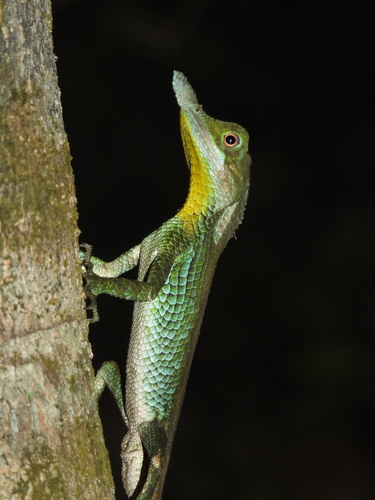
Ceratophora tennentii, also referred to as C. tennentii, has a leaf-like appendage at the tip of its nose.
Total Length
This species can reach total lengths of over 8 inches (20 cm) when including the tail.
Sexual Coloration Difference
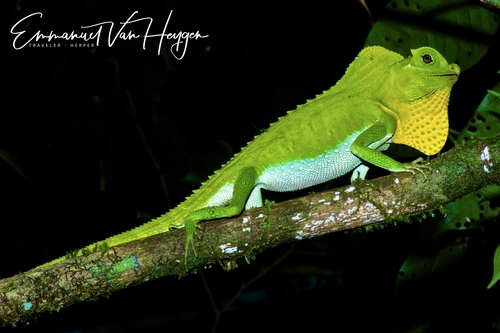
Males typically have more green in their coloration than females, though both sexes can change color to a reddish brown.
Sexual Nasal Appendage Difference
Females usually have a shorter nasal appendage than males.
Predator Avoidance
C. tennentii is not very agile, and it relies more on its coloration than speed to avoid predators.
Head Shape
Its head is oval, and it is longer than it is wide.
Rostral Appendage Structure
The rostral (nasal) appendage is fleshy, laterally compressed, and leaf-like, with a bluntly conical scale at its tip.
Toe Lamellae Count
There are 23 to 30 lamellae under the fourth toe.
Dorsal Coloration
The dorsum (back) ranges from reddish brown to olive green.
Flank Scale Coloration
The larger scales on the flanks are more green in color.
Throat and Neck Markings
The gular (throat) region and the sides of the neck have dark markings.
Tail Pattern
The tail has 20 dark brown cross-bands.
Venter Coloration
The venter (belly) is cream-coloured.
Primary Distribution
C. tennentii occurs in the wet tropical montane cloud forests of the Knuckles mountains in Sri Lanka, at elevations between 760–1,220 m (2,490–4,000 ft).
Additional Habitat Records
It has also been recorded in several other types of forest habitat.
Reproduction
C. tennentii is a sexually reproducing species that lays eggs.