About Cephalanthera longifolia (L.) Fritsch
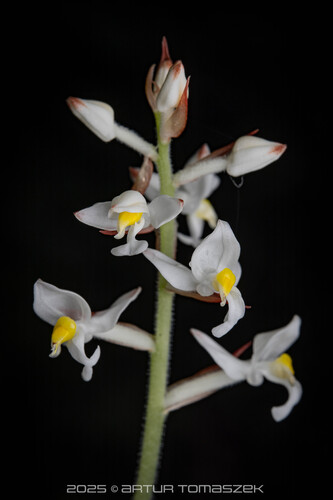
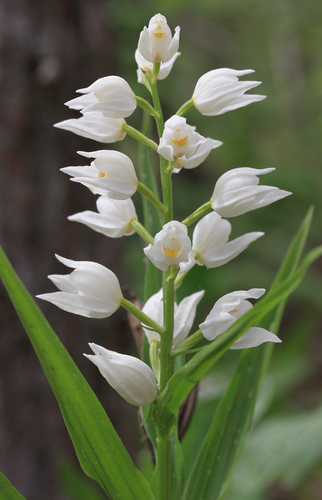
Cephalanthera longifolia, commonly called sword-leaved helleborine, reaches an average height of 20–60 centimetres (7.9–23.6 in) under typical growing conditions. This orchid produces multiple erect, glabrous stems. Its leaves are dark green, long, and narrowly tapered, which gives the species its common common name. The inflorescence is a loose spike holding 5 to 20 bell-shaped flowers arranged in an oblique ascending spiral. The flowers are white, around 1 cm (0.4 in) long, and have a labellum edged with yellow. They usually only open during the warmest, brightest hours of the day. This plant blooms from April to June, with timing varying by location and altitude. Its fruit is a dry capsule, and its dust-like seeds are dispersed by wind. An unusual trait of this species is that some individuals are achlorophyllous, meaning they lack green pigment, and get all of their nutrition from mycorrhizal fungi. Cephalanthera longifolia is common in some parts of its European range, including southern France and Spain, but it is endangered especially in northern areas such as Belgium. In Britain and Ireland, it is an uncommon and declining species, and conservation work is underway at multiple sites to protect it. In 2007, it was listed as a priority species under the UK Biodiversity Action Plan, and the charity Plantlife International leads this conservation work in the United Kingdom. Sword-leaved helleborine most often grows in damp woodland, primarily oak and beech woodland, as well as on forest edges and rocky slopes. It prefers calcareous soils and well-exposed sites, growing at altitudes between 0 and 1,400 metres (0–4,593 ft) above sea level. This species was once abundant when forests were used for livestock grazing and coppicing, but it is now threatened by overgrowth from larger plants. Its flower spikes are eaten by deer, so it is also threatened by growing deer populations that have followed the extirpation of large predators such as wolves and brown bears across much of Europe. The flowers of Cephalanthera longifolia are pollinated by solitary burrowing bees. The flowers produce very little nectar, and the yellowish dust on the labellum that insects collect has little nutritional value. The actual pollen is held in two pollinia that stick to the hairs on a bee's back. A study conducted in Estonia found that the mycorrhizal partners of this orchid species include Thelephoraceae and Helotiales. Another study found the species has 9 mycorrhizal partners, which is still fewer than the number recorded for Cephalanthera damasonium; confirmed partners include Bjerkandera adusta, Phlebia acerina, Sebacinaceae, Tetracladium sp., and Tomentella sp. Cephalanthera longifolia is vulnerable to grazing by deer.