About Pheladenia deformis (R.Br.) D.L.Jones & M.A.Clem.
Growth Form
Pheladenia deformis is a terrestrial, perennial, deciduous, sympodial orchid herb.
Root and Tuber Structure
It has a few inconspicuous fine roots, and a tuber that is partly surrounded by a fibrous sheath. This tuber produces two droppers that develop into daughter tubers the following year.
Leaf Characteristics
A single hairy convolute leaf grows at the base of the plant; the leaf is linear, 3–10 cm long and 2–5 mm wide, with a few hairs around 1 mm long, especially along its edges.
Flower Stem
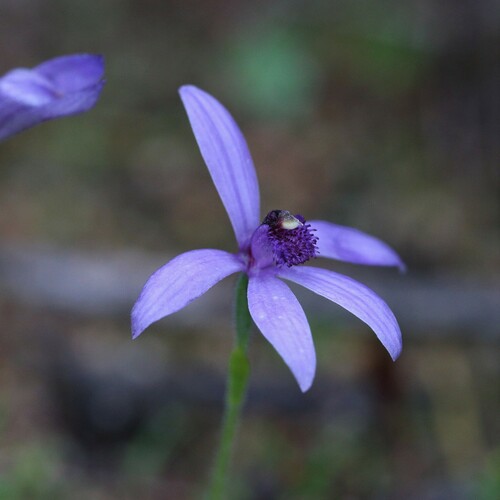
There is usually a single flower borne on a stem that is 5–15 cm high.
Sepal and Petal Dimensions
The three sepals and two lateral petals are 14–20 mm long and 3–5 mm wide.
Perianth Coloration and Surface
Their outer surface usually has a small number of glandular hairs, while the inner surface is bright blue, or occasionally white, pinkish, or yellow.
Labellum Modification
Like most orchids, one petal of this species is highly modified into a central labellum.
Labellum Appearance
The labellum is dark blue near its tip and white near its base, 10–14 mm long and 4–6 mm wide.
Common Name Origin
The edge of the labellum is fringed and covered in many stalked calli, which gives the species its common name blue beard.
Column Structure
The column is 7–10 mm long and 3–4 mm wide.
General Habitat Range
This orchid, commonly called the blue fairy orchid, grows in a wide range of habitats, including swamp margins, granite outcrops, heath, woodland, and forest.
National Distribution
It occurs in every Australian state except Queensland and the Northern Territory.
Western Australia Distribution
In Western Australia, it grows from north of Kalbarri east to Israelite Bay on the south coast.
New South Wales Distribution
In New South Wales, it is uncommon, but sometimes forms clumps on the Central West Slopes and South West Plains south of Molong.