About Campephilus magellanicus (P.P.King, 1827)
Scientific Name & Body Length
The Magellanic woodpecker, with the scientific name Campephilus magellanicus (P.P.King, 1827), has a body length ranging from 36 to 45 cm (14 to 18 in). Males of the species weigh between 312 and 369 g (11.0 to 13.0 oz), while females weigh 276 to 312 g (9.7 to 11.0 oz).
Standard Morphometric Measurements
Standard measurements for the species are as follows: wing chord 20.5 to 23 cm (8.1 to 9.1 in), tail 13.9 to 16.8 cm (5.5 to 6.6 in), bill 4.3 to 6 cm (1.7 to 2.4 in), and tarsus 3.3 to 3.9 cm (1.3 to 1.5 in).
Size Relative To Other Woodpeckers
It is the largest woodpecker found in South America and ranks among the largest woodpecker species in the world. Only the non-neotropical members of the genus Dryocopus and the great slaty woodpecker (Mulleripicus pulverulentus) are larger-bodied than this species among currently existing woodpeckers.
Status As Largest Living Campephilus
Since the ivory-billed woodpecker and imperial woodpecker (Campephilus imperialis) are likely extinct, the Magellanic woodpecker is the largest living species in the genus Campephilus. With an average male weight of 339 g (12.0 oz) and average female weight of 291 g (10.3 oz), it is possibly the heaviest definitely surviving woodpecker in the Americas.
Plumage & Beak Characteristics
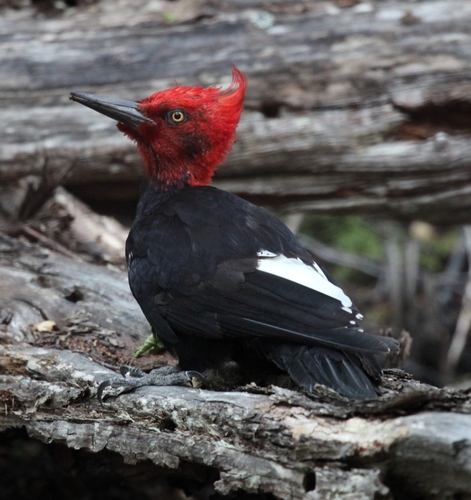
This species is mostly solid black, with a white patch on the wing and a grey, chisel-shaped beak. Males have a crimson head and crest.
Female & Juvenile Plumage
Females have a mostly black head, with a patch of red coloring near the base of the bill. Juvenile Magellanic woodpeckers look similar to adult females, but have smaller crests and a browner tint to their plumage.
Distinctiveness In Native Range
Within its native range, this bird has a very distinctive, easy-to-identify appearance.
Vocalization Research Need
Both males and females produce a range of vocalizations. More research is required to confirm the functions and roles of these different sounds.
Common Single Or Series Call
One common vocalization is an explosive, nasal call transcribed as tsie-yaa or pi-caa, which is given as a single call or in a series of up to seven, sometimes more, calls.
Pair Produced Gargling Call
Another loud call, typically produced by pairs, is a gargling call that is normally emitted in a series, transcribed as prrr-prr-prrr or weeerr-weeeeerr.
Drumming Behavior
Like many species in the genus Campephilus, the Magellanic woodpecker produces a loud double knock when drumming.
Habitat Preferences
Magellanic woodpeckers live in mature Nothofagus forests and mixed Nothofagus-Austrocedrus forests.
Primary Diet Components
In these habitats, they feed primarily on wood-boring grubs, adult beetles from the order Coleoptera, and spiders.
Supplemental Diet Items
Occasionally, their diet is supplemented by other foods including sap, fruits, small reptiles, bats, and the eggs and nestlings of passerine birds.
Known Predators
A number of potential predators of the Magellanic woodpecker have been recorded, almost all of which are avian raptors. Known predators include white-throated hawks (Buteo albigula), variable hawks (B. polyosoma), bicolored hawks (Accipiter bicolor), and crested caracaras (Caracara plancus); crested caracaras most likely only prey on young Magellanic woodpeckers.
Non-Nesting Predator Response
When Magellanic woodpeckers encounter these potential predators outside of the nesting season, they typically respond by becoming quiet and remaining still.
Nesting Season Predator Response
However, they will often aggressively attack raptorial birds during the nesting season.