About Ceiba chodatii (Hassl.) Ravenna
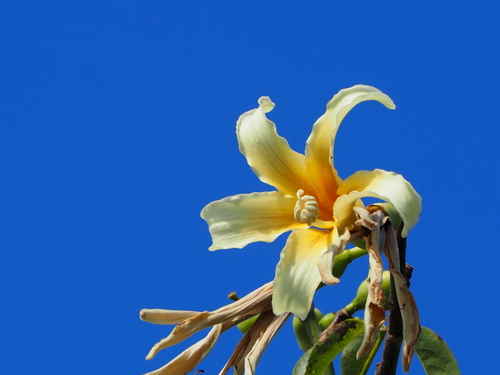
Ceiba chodatii is a medium-sized deciduous tree that grows to roughly 12 metres (39 ft) tall. It has a tall, stout bare trunk that becomes swollen with age, with a number of thick branches growing from the top of the trunk, forming a rounded crown. The bark is smooth, marked with vertical ridges and horizontal wrinkles. Young bark contains chlorophyll, is green, and can carry out photosynthesis; the bark turns grey as the tree ages. The trunk is covered in thick, woody conical spines. Its alternate leaves are palmate, with five lobes and serrated edges. The flowers are large, solitary, and creamy white with a few purple flecks. They can reach up to 15 centimetres (5.9 in) in length, with yellow-green calyces and funnel-shaped corollas; the corollas have five fleshy, hairy petals that are joined at their bases. The fruit produced by this species is a large, oblong green capsule. When ripe, the capsule splits open to reveal black seeds surrounded by a mass of white fibres that resemble cotton. Ceiba chodatii is native to seasonally dry woodland habitats; it occurs naturally in Bolivian forests, the Chaco region of Paraguay, and the Piedmont Mountains of western Argentina. This species flowers between February and May. Flowers of Ceiba chodatii open at dusk, and are probably pollinated by sphingid moths. While other members of the Ceiba genus are pollinated by bats, bat pollination is considered unlikely for Ceiba chodatii because its flowers produce very little nectar. Hummingbirds also visit the flowers of this tree, but do not come into contact with the anthers or stigma. Self-pollination cannot occur in this species, due to a late-acting form of self-incompatibility. The bottle-shaped swollen trunk of Ceiba chodatii stores retained water for the tree to use during the dry season. Indigenous people of the Chaco region harvest this stored water to give to their cattle. The timber of this tree is used to build canoes and make various articles for daily use. Fibres from the trunk are woven into ropes, bark extracts are used for tanning leather and as a dye. In the dry Chaco habitat where Ceiba chodatii grows, the landscape features dense spiny woodlands made up of low trees, with an understorey containing the genera Aspidosperma, Astronium, Schinopsis, Ceiba, and Bulnesia. The ground is covered by thorny plants: some have small microphyll leaves, others are leafless, and the habitat is also home to cacti including Cereus and Stetsonia. Some plants in this habitat, such as Jacaratia, store water in specialized tubercles.