About Cassia javanica L.
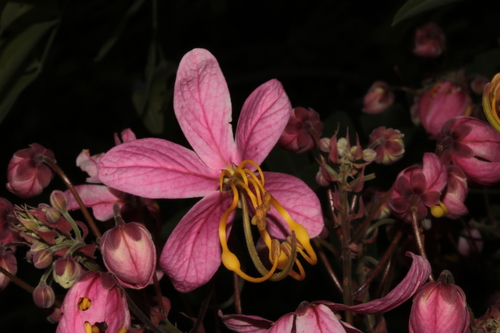
Cassia javanica L. is a fast-growing deciduous or semi-deciduous tree that flowers in spring and sheds its leaves during winter. It has a straight trunk, and reaches an overall height between 25 and 40 meters. Its leaves are paripinnate, with 12 pairs of elliptical leaflets. Its flowers grow in open clusters, and range in color from pale pink to crimson, with yellow stamens. Towards the end of the flowering season, fallen petals form a beautiful pink carpet across the ground under the tree. Its fruit develops inside long, cylindrical, dark brown pods. Due to its attractive appearance and manageable size, C. javanica is planted as a shade and ornamental tree along streets and in parks. This species is polymorphic, and multiple subspecies are recognized. The natural range of Cassia javanica L. extends from Assam in far northeastern India, through southern China, and south across Malesia and Papuasia to Queensland, Australia. It has also been introduced to many other tropical regions, including parts of India outside its native range, Hawaii, Sri Lanka, tropical America, and tropical Africa. Medicinally, C. javanica is used as a substitute for Cassia fistula to treat constipation, colic, chlorosis, and urinary disorders. Its leaves are effective against herpes simplex, and its bark is included as an ingredient in Ayurvedic and other traditional medicine antidiabetic formulations. This tree produces hardwood ranging from lightweight to heavy, which is used for general construction, furniture, and cabinet making. Its bark is also used for tanning in the leather processing industry.