About Acacia neriifolia A.Cunn. ex Benth.
Taxonomic Identity
Acacia neriifolia A.Cunn. ex Benth. is an evergreen tree or shrub.
Size
It typically grows 3 to 8 metres (9.8 to 26.2 feet) tall, and can reach up to 8 metres (26 feet) wide.
Growth Habit
It most often has an erect to spreading growth habit, with branchlets that become flattened or angled toward their tips.
Branchlet Characteristics
The branchlets are covered in fine silvery white hairs, which may look yellowish on young shoots, and the branchlets are often coated in a fine white powder.
Foliage Type
Like most Acacia species, this plant has phyllodes instead of true leaves.
Phyllode Shape
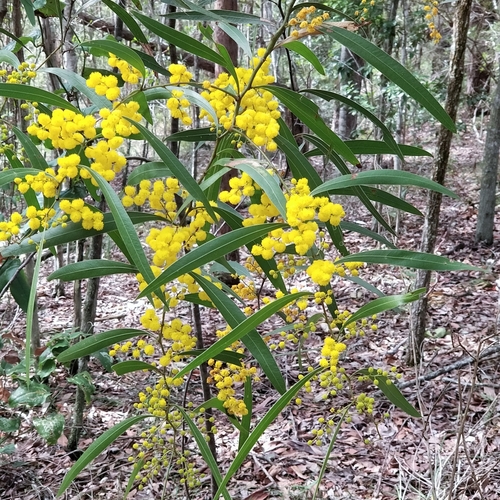
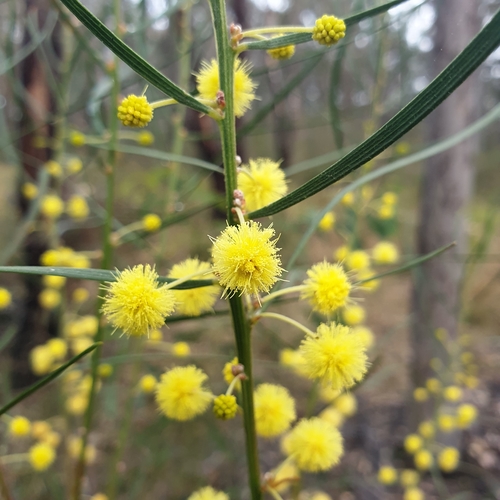
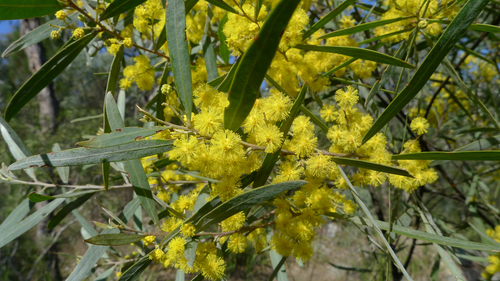
These silvery-green phyllodes are roughly linear to narrowly elliptic in shape, and are either straight or slightly curved.
Phyllode Measurements and Features
They measure around 5 to 15 centimetres (2.0 to 5.9 inches) long and 4 to 9 millimetres (0.16 to 0.35 inches) wide, are covered in fine hairs, and have a clearly visible prominent midvein.
Flowering Period and Inflorescence Structure
It blooms between July and October, producing inflorescences grouped in clusters of 8 to 20 on an axillary raceme, along a central axis that is 3 to 9 centimetres (1.2 to 3.5 inches) long.
Flower Head Characteristics
The spherical flower heads are 3.5 to 7 millimetres (0.14 to 0.28 inches) in diameter, and hold 20 to 40 yellow to bright yellow flowers.
Seed Pod Characteristics
After flowering, it forms thinly leathery, flat seed pods that are straight to slightly curved, 6 to 18 centimetres (2.4 to 7.1 inches) long and 6 to 10 millimetres (0.24 to 0.39 inches) wide.
Endemic Range
This species is endemic to Queensland and New South Wales in Australia.
Distribution in New South Wales
In New South Wales, it grows on the eastern tablelands and slopes of the Great Dividing Range, extending from around Tamworth and Barradine in the south northward into Queensland.
Natural Habitat
It is commonly found around granite outcrops, as a member of dry sclerophyll forest and woodland plant communities.
Cultivation Uses
When grown in cultivation in gardens, it is useful as a shade tree or an informal screen.
Cultivation Requirements
It grows well in full sun or partial shade, and is drought tolerant.