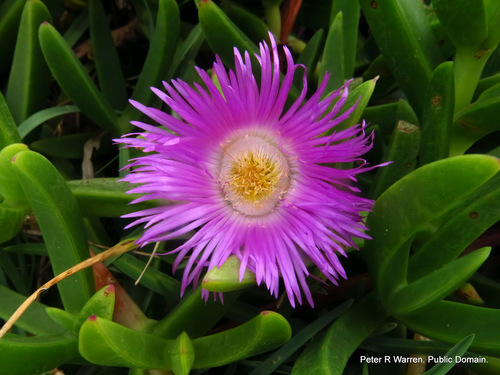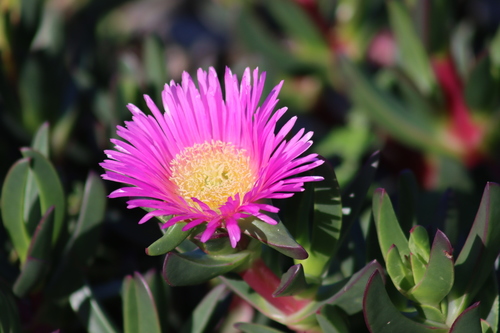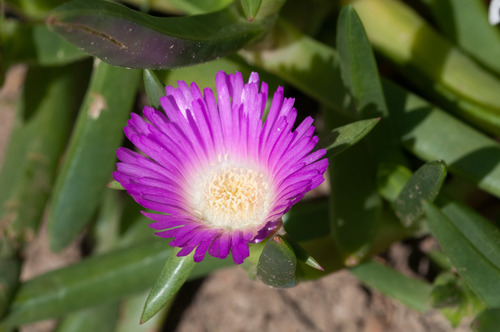
About Carpobrotus rossii (Haw.) Schwantes
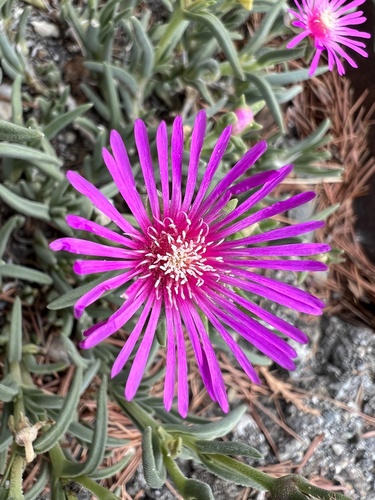
Carpobrotus rossii, commonly called karkalla, produces succulent leaves that measure 3.5–10 cm (1.4–3.9 in) long and 1 cm (0.4 in) wide. Leaves are usually curved, and only rarely straight. Flowers bloom from August to October, are light purple, and reach 6 cm (2.4 in) in width. The species forms globular purplish red fruit that is roughly 2.5 cm (1 in) long and 1.5 cm (0.6 in) wide. This species grows naturally in the Australian states of Western Australia, South Australia, Tasmania and Victoria. It can be found year-round growing in large patches that cover sand dunes near the ocean, a habitat it tolerates well thanks to its hardiness and natural salt resistance. Traditionally, Aboriginal people eat the fruit of this plant both fresh and dried. The plant's salty leaves have also been eaten alongside meat. Extracts from Carpobrotus rossii have shown significant in vitro antioxidant, antiplatelet, and anti-inflammatory activity.