About Carpobrotus glaucescens (Haw.) Schwantes
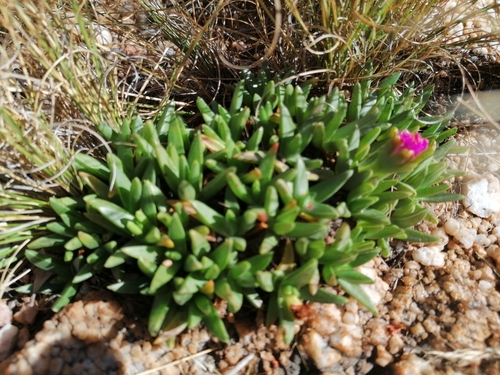
Carpobrotus glaucescens (Haw.) Schwantes is a prostrate plant with stems growing up to 2 metres (6 feet 7 inches) long. Its leaves are glaucous, triangular in cross-section, straight or slightly curved, and measure 35–100 mm (1.4–3.9 in) long and 9–15 mm (0.35–0.59 in) wide.
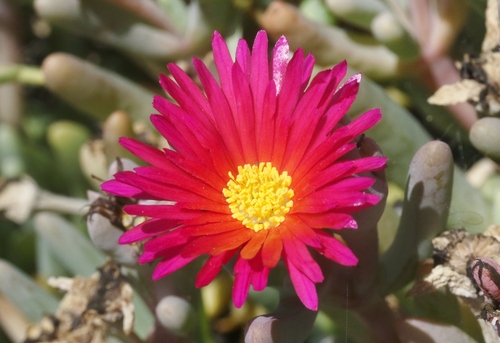
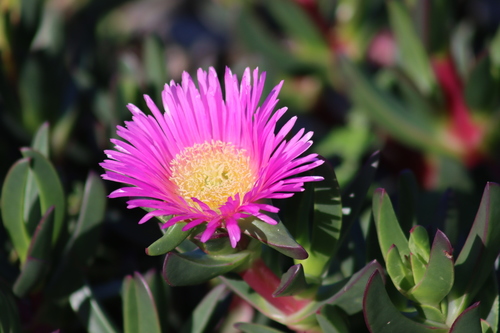
The flowers of this species are superficially daisy-like, more or less sessile, and 40–60 mm (1.6–2.4 in) in diameter. They have 100 to 150 light purple to deep pinkish-purple staminodes arranged in three or four rows, which are white near their base. There are also around 300 to 400 stamens arranged in five or six rows, plus seven to ten styles. The mature fruit is red to purple, more or less cylindrical, 20–30 mm (0.79–1.18 in) long and 16–24 mm (0.63–0.94 in) wide.
In terms of distribution and habitat, C. glaucescens grows in near-coastal areas spanning from south of near Mackay in Queensland, through New South Wales, to far eastern Victoria, Australia, where it has often been confused with C. rossii. It is also native to Norfolk Island and Lord Howe Island. A population exists on the Coromandel Peninsula in New Zealand, but it may be an introduced species in this location.
Aboriginal peoples traditionally used the fruit of C. glaucescens as a food source; the fruit flesh is reported to have a taste similar to salty apples. The plant's fleshy leaves can be eaten raw or cooked, and roasted leaves are used as a salt substitute. Early European explorers used this plant to treat scurvy. Leaf juice can also be applied to relieve burnt skin or soothe stings and bites, including those from biting midges and Portuguese man o' war (Physalia physalis).