About Caroxylon imbricatum (Forssk.) Akhani & Roalson
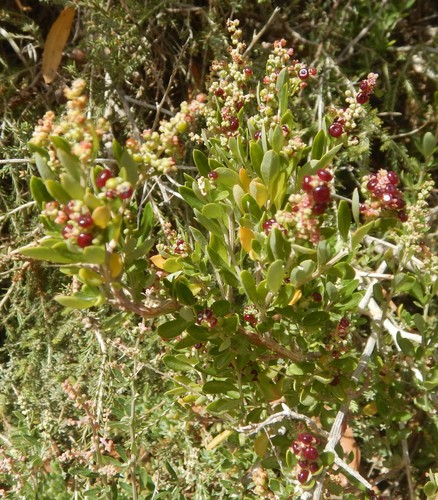
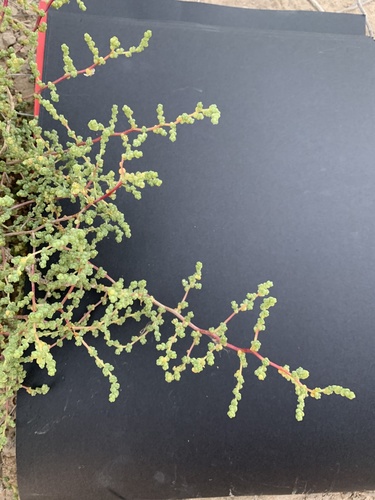
Caroxylon imbricatum is a small, spreading shrub or sub-shrub that can grow up to 1.2 m (4 ft) tall. Its grey or reddish stems reach up to 2 cm (0.8 in) thick, and both these stems and the plant’s lower leaves are densely covered in hairs. In the upper sections of the plant, stems are creamy or pale grey and branch frequently: some branches grow vertically, while others spread horizontally. Regularly arranged, catkin-like branchlets extend out from the branches. The leaves are tiny, succulent, and shaped like linear or narrowly triangular structures. Its inflorescence is spike-shaped, with bracts that resemble the plant’s leaves; it produces small flowers that have five petals, five stamens, and two styles. The fruiting perianth is equipped with silky wings. This species has a widespread distribution across the desert belt of Saharan Africa, the Arabian Peninsula, southern Iran, Pakistan, Afghanistan, and northwestern India. It typically grows in disturbed areas including runnels, washes, dry wadis, eroded slopes, and coastal cliffs. It can grow on various soil types, and as a ruderal species, it colonizes fallow land and over-grazed pastures. Caroxylon imbricatum is a halophytic plant. When exposed to salt stress, the plant increases its water content to become more succulent, and reduces the surface area of its leaves. Germination rate tests on this species’ seeds have found that seeds sprout more quickly and consistently at 20 °C than at higher temperatures, and that germination rates are higher at lower salinity levels than at high salinity levels. However, seeds that were exposed to high salinity levels recovered their germination potential after being immersed in unsalted water. This species has traditionally been used as a vermifuge, and for treating certain skin disorders. Five triterpene glycosides have been isolated from the roots of Caroxylon imbricatum, and two of these are new glycoside derivatives that had not been previously identified.