About Cardamine hirsuta L.
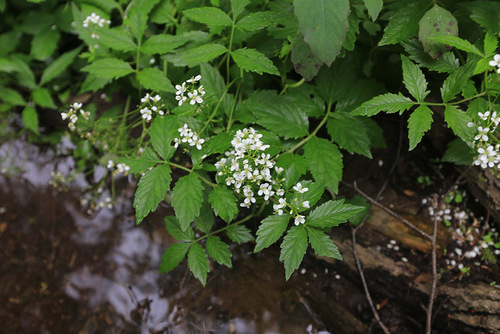
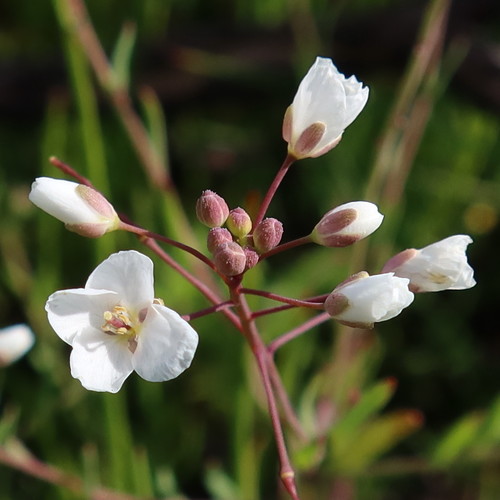
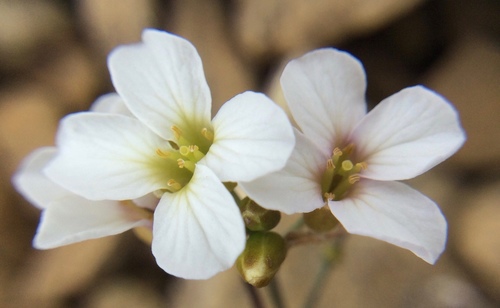
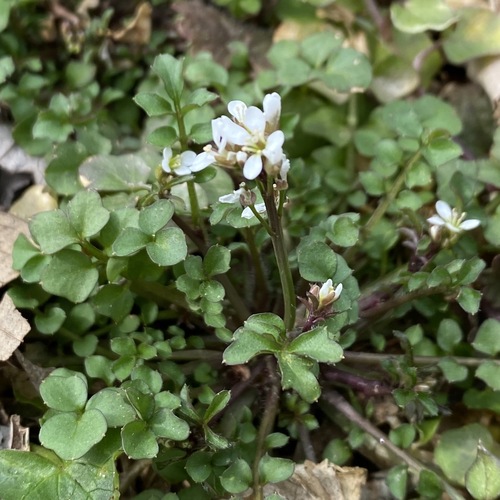
Cardamine hirsuta L., commonly called hairy bittercress, has a life cycle that varies with climate. It may complete two generations per year, one in spring and one in fall. Depending on climate, seeds can germinate in fall, with plants staying green over winter to flower the following spring. This species usually forms an erect growth habit, reaching a maximum height of around 30 centimeters; stems are either unbranched or branched near the base. It most often grows a basal rosette of leaves at the stem base, with most leaves located in this rosette, though some leaves may grow on the upright stem. The pinnately divided leaves of the basal rosette have 8–15 leaflets connected to the petiole by short stems. Basal leaves typically measure 3.5–15 cm (1.4–5.9 in) in length. Leaflets range from round to ovate in shape, and can have either smooth or toothed edges. The terminal leaflet at the tip of the leaf is larger than the other leaflets, and is shaped round to reniform. Cauline leaves, which attach to the upright stem, are also pinnately divided, but have fewer leaflets and are generally smaller than basal leaves. Cauline leaves grow on a petiole and are 1.2–5.5 cm (0.5–2.2 in) long. Stems, petioles, and the upper surfaces of cauline leaves are sparsely hairy. Small white flowers grow in bract-free racemes, and plants often continue flowering while their first seeds ripen. Flowers almost always have 4 spatulate-shaped white petals 1.5–4.5 mm long, though petals are occasionally absent. Unlike most closely related species that have 6 stamens, Cardamine hirsuta has 4 stamens of equal height. Pollen grains are elongated, approximately 32 microns long. Below the flower are 4 oblong sepals, 1.5–2.5 mm long and 0.3–0.7 mm wide. Seeds are held in upright, straight siliquae that are 1.5–2.5 cm long and 1–1.4 mm in diameter. When the fruit is ripe and touched, the siliqua valves coil tightly from bottom to top and burst explosively, ejecting seeds far from the parent plant. This seed dispersal method is called ballochory, a type of rapid plant movement. Hairy bittercress is very similar to Cardamine flexuosa, with several key differences: Cardamine hirsuta stems are hairless, its leaves do not clasp the stems, it usually has only 4 stamens (compared to 6 in C. flexuosa), and its fruits grow above the flowers, while C. flexuosa fruits do not rise above younger flowers. Fruits grow as a single row in thin pods. Cardamine hirsuta has a chromosome number of 2n = 16. This species is native to Europe, the Middle East, South Asia, Southeast Asia, Central Asia, North Africa, Central Africa, and the Horn of Africa. It is commonly found growing in damp, recently disturbed soil, open ground, turf, and waste places. Because these conditions are common in nursery and garden centre stock, hairy bittercress seeds are often introduced to new areas alongside these plants. Once established, it is difficult to eradicate. It has been introduced to many countries across the world, including (but not limited to) Argentina, Australia, Canada, China, Colombia, Costa Rica, Ecuador, Gabon, Great Britain, India, Japan, Laos, Madagascar, Mexico, Pakistan, Panama, Peru, the Philippines, South Africa, Sri Lanka, Thailand, Turkmenistan, the United States, Venezuela, and Vietnam. Its tiny flowers attract a small number of early butterfly species; in the United States, these include the spring azure (Celastrina ladon) and the falcate orange-tip (Anthocharis midea). The 1889 book The Useful Native Plants of Australia records that this species is also called "Lady's Smock", and notes that this and related species make excellent pot-herbs when they are growing luxuriantly and are flaccid, and that the present species is a common weed almost worldwide. The leaves, flowers, and seedpods of Cardamine hirsuta are edible raw or cooked, and are described as having a mild peppery taste. In Georgia and Eastern Europe, the leaves are used in salads, while the seeds work well as a substitute for mustard.