About Arabidopsis lyrata (L.) O'Kane & Al-Shehbaz
Species Identity and Growth Form
Arabidopsis lyrata (L.) O'Kane & Al-Shehbaz is a diploid perennial plant, reaching 10–40 centimetres (4–16 in) in height.
Basal Leaves and Flower General Appearance
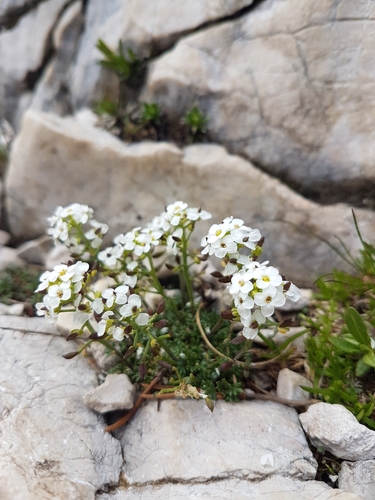
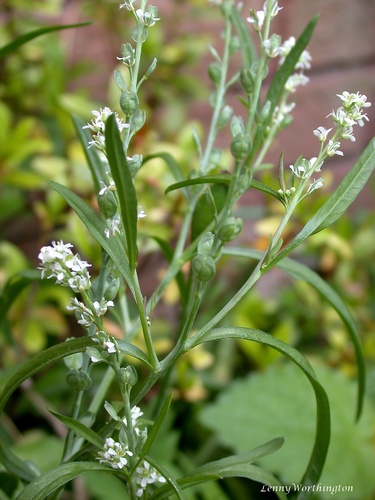
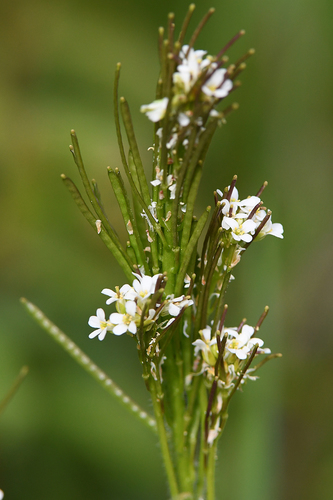
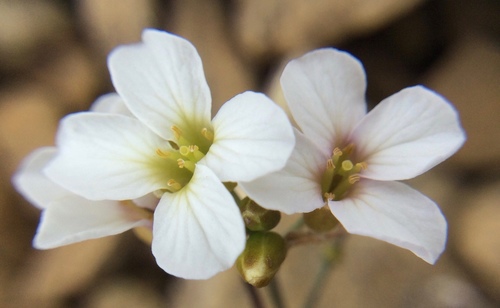
It has highly distinct basal leaves, and small pure white flowers.
Stem Leaf Morphology
Stem leaves are arranged alternately, with linear, slightly curved smooth margins and tapered bases.
Leaf Defense Mechanisms
The species’ leaves produce glucosinolates and have trichomes, which act as defense mechanisms against insect herbivores and other potential threats such as fires and human activity.
Individual Flower Size
Individual flowers are very small, measuring 3–8 mm across.
Flower Structure and Pedicel Characteristics
They have four lobes, and grow on widely ascending pedicels that are 7 to 12 mm long.
Pollination and Reproductive Timing
This species is insect pollinated, and blooms from May through June, with fruits developing in early August.
Fruit Morphology
Fruits are elongated, papery, and 2–4.5 millimetres (0.08–0.18 in) long.
Seed Characteristics
Seeds are 1 mm (0.04 in) long and arranged in a single row.
General Habitat Range
Arabidopsis lyrata occurs mostly in subarctic or subalpine areas with thin soils, including rock faces, eskers, talus slopes, and exposed coastal zones.
Growth Form and Asexual Reproduction
Individual plants can grow as solitary rosettes, and reproduce asexually through clonal patches.
Competitive Habitat Requirements
This species cannot survive in agro-ecosystems with abundant weeds, and grows best under low competition.
Life Cycle Light Requirements
Its life cycle relies on completing germination, growth, and seed set in a very short window before other plant species block access to light.
Global Distribution
It has a circumpolar distribution, found across northern and central Europe, Asia, and North America.
Virginia Habitat Specifics
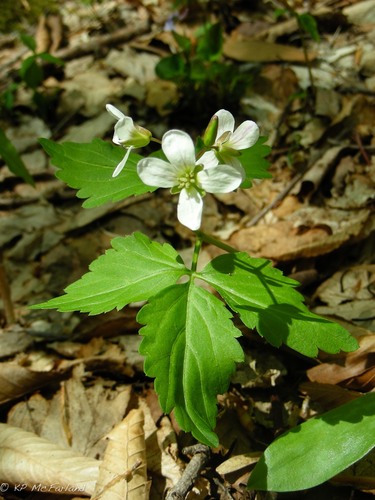
In the U.S. state of Virginia, it grows in rocky woodlands, barrens, and crevices or thin-soiled ledges on outcrops of limestone, dolomite, siltstone, metasiltstone, amphibolite, metabasalt, diabase, and other mafic and felsic igneous and metamorphic rocks.
Eastern U.S. Habitat
It also occurs in eastern United States, where it is usually restricted to sand bars.
European Distribution
In Europe, it is found in southern Germany and restricted areas of Sweden.
Mating System Variation
For North American populations of Arabidopsis lyrata ssp. lyrata, outcrossing is typical in the center of the species’ range, while populations at range margins shift toward selfing.