About Caracal caracal (Schreber, 1776)
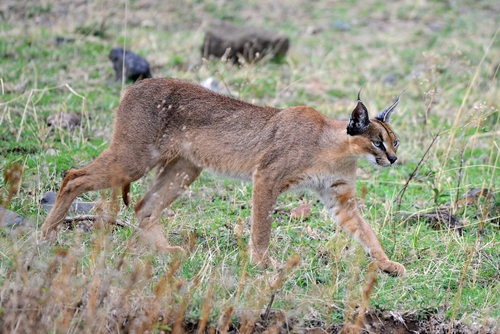
Caracal (Caracal caracal (Schreber, 1776)) is a moderately sized, slender cat with a robust build, short face, long canine teeth, tufted ears, and long legs. It stands 40–50 cm (16–20 in) tall at the shoulder. Its tan, bushy tail reaches the animal's hocks. Caracals are sexually dimorphic, with females smaller than males across most body measurements. Its distinct facial features include 4.5 cm (1.8 in) long black ear tufts, two black stripes running from the forehead to the nose, black outlines around the mouth, other distinctive black facial markings, and white patches surrounding the eyes and mouth. Its narrowed-looking eyes, caused by a lowered upper eyelid, are likely an adaptation to block sun glare. Ear tufts may begin to droop as the caracal ages. The coat is typically uniformly reddish tan or sandy, though all-black individuals are known. The underbelly and inner sides of the legs are lighter, and often have small reddish markings. The fur is soft, short, and dense, and becomes coarser during summer. Ground hairs are denser in winter than in summer. Guard hairs can grow up to 3 cm (1.2 in) long in winter, and shorten to 2 cm (0.79 in) in summer. These seasonal changes indicate moulting occurs in the hot season, typically in October and November. The hind legs are longer than the forelegs, making the caracal's body slope downward from the rump. Male caracals have a head-to-body length of 78–108 cm (31–43 in) and a tail 21–34 cm (8.3–13.4 in) long. A sample of 77 males weighed between 7.2 and 19 kg (16 and 42 lb). Females have a head-to-body length of 71–103 cm (28–41 in) with a tail 18–31.5 cm (7.1–12.4 in) long; a sample of 63 females weighed between 7 and 15.9 kg (15 and 35 lb). Caracals are often confused with lynxes, as both have tufted ears. A key difference is that lynx species have spotted and blotched coats, while caracals have no such markings. The African golden cat has a similar build to the caracal, but is darker and does not have ear tufts. The sympatric serval can be told apart from the caracal because servals lack ear tufts, have white spots behind the ears, a spotted coat, longer legs, a longer tail, and smaller footprints. The caracal's skull is high and rounded, with large auditory bullae, a well-developed supraoccipital crest connected to the sagittal crest, and a strong lower jaw. Caracals have a total of 30 teeth, with a permanent dental formula of 3.1.3.1 / 3.1.2.1, and a deciduous dental formula of 3.1.2 / 3.1.2. The canines are up to 2 cm (0.79 in) long and sharp. Caracals do not have second upper premolars, and their upper molars are very small. The large paws have four digits on the hind legs and five on the fore legs. The first fore leg digit stays above ground and bears the dewclaw. The sharp, retractile claws are larger but less curved on the hind legs. In Africa, the caracal is widely distributed south of the Sahara, and is considered rare in North Africa. In Asia, it ranges from the Arabian Peninsula and Middle East through Turkmenistan and Uzbekistan to western India. It lives in forests, savannas, marshy lowlands, semideserts, and scrub forests, and prefers dry areas with low rainfall and available cover. In mountain habitats such as the Ethiopian Highlands, it occurs up to 3,000 m (9,800 ft) in elevation. In Ethiopia's Degua Tembien massif, caracals can be seen along roads, sometimes as roadkills. In spring 2019, camera traps photographed a male caracal in Jebel Hafeet National Park in the Al Ain Region of the Emirate of Abu Dhabi; this was the first such record since the mid-1980s. A caracal was spotted in Wadi Wurayah in the Emirate of Fujairah in October 2025. In south-western Turkey, caracals live in a wildlife reserve spanning the provinces of Antalya and Muğla, which is regularly used for recreational and agricultural activities. Even so, caracals avoid humans and are active mostly at night. In Uzbekistan, caracals have only been recorded in the desert regions of the Ustyurt Plateau and Kyzylkum Desert. Between 2000 and 2017, 15 living individuals were sighted, and at least 11 were killed by herders. In Iran, caracals have been recorded in the Abbasabad Naein Reserve, Bahram'gur Protected Area, Kavir National Park, and Yazd province. In India, the caracal lives in Sariska Tiger Reserve and Ranthambhore National Park. Its current range in India is limited to Rajasthan, Gujarat, and Madhya Pradesh, and the Indian population may number fewer than 100 individuals. Caracals are typically nocturnal, though some activity may also be observed during the day. They are so secretive and difficult to observe that their daytime activity may easily go unnoticed. A study in South Africa found that caracals are most active when air temperature drops below 20 °C (68 °F), and activity typically stops at higher temperatures. Caracals are solitary, and mostly occur alone or in pairs; the only groups observed are mothers with their offspring. Females in oestrus form temporary pairs with males. Caracals are territorial, and mark rocks and vegetation in their territory with urine, and likely also with dung that they do not cover with soil. Claw scratching is a common marking behavior, and they typically do not create dung middens. In Israel, male caracals have an average territory size of 220 km2 (85 sq mi), while females average 57 km2 (22 sq mi). In Saudi Arabia, male territories range from 270–1,116 km2 (104–431 sq mi). In Mountain Zebra National Park, female home ranges vary between 4.0 and 6.5 km2 (1.5 and 2.5 sq mi). Territories overlap extensively. The caracal's noticeable ear tufts and facial markings often function as a method of visual communication; caracals have been observed interacting by moving their heads from side to side to make the tufts flicker rapidly. Like other cats, caracals meow, growl, hiss, spit, and purr. Both sexes reach sexual maturity by one year old; gamete production begins even earlier, at seven to ten months. Successful mating only occurs when individuals are 12 to 15 months old. Breeding occurs year-round. Oestrus lasts one to three days, and recurs every two weeks unless the female is pregnant. Females in oestrus show a sharp increase in urine marking, and form temporary pairs with males. Mating has not been extensively studied; limited observations suggest copulation, which averages nearly four minutes in length, begins when the male smells areas the female has marked with urine, after which the female rolls on the ground. The male then approaches and mounts her. The pair separates after copulation. Gestation lasts around two to three months, after which a litter of one to six kittens is born. Births generally peak between October and February. Births happen in dense vegetation or abandoned burrows dug by aardvarks and porcupines. Kittens are born with their eyes and ears closed, and their claws are not yet retractable. Their coat resembles that of adults, but their abdomen is spotted. Eyes open by ten days of age, but vision takes longer to become fully functional. The ears become erect and claws become retractable by the third or fourth week. Around this same time, kittens begin exploring their birth site, and start playing with each other by the fifth or sixth week. They begin eating solid food around this time, but must wait nearly three months before making their first kill. As kittens start moving on their own, the mother moves them to a new location every day. All milk teeth emerge by 50 days, and permanent dentition is fully developed by 10 months. Juveniles begin dispersing at nine to ten months, though a small number of females stay with their mothers. The average lifespan of a caracal in captivity is nearly 16 years. In the 1990s, a captive caracal mated spontaneously with a domestic cat at the Moscow Zoo, producing a hybrid felid offspring.