About Capricornis crispus (Temminck, 1836)
Taxonomy and Naming
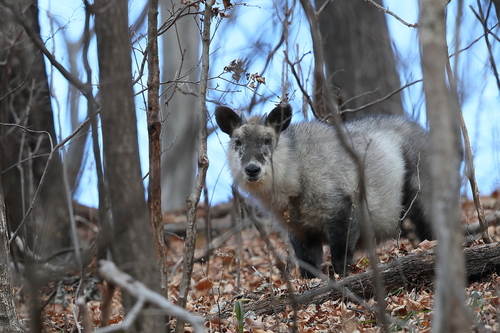
The Japanese serow, also called kamoshika (lit. "coarse pelt deer"), with the scientific name Capricornis crispus, is a Japanese goat-antelope and an even-toed ungulate.
Habitat and Cultural Status
It lives in dense woodland in Japan, primarily in northern and central Honshu. It is a national symbol of Japan and receives protection in conservation areas.
Physical Dimensions
Adult Japanese serow stand about 81 centimetres (32 in) tall and weigh 30–45 kilograms (66–99 lb).
Coat Characteristics
Their coloring ranges from black to whitish, and lightens in summer. They have very bushy fur, especially on the tail.
Sexual Dimorphism
Both sexes have short, backwards-curving horns and are hard to tell apart by sight.
Wild Diet
Japanese serow live in dense mountain forests, where they eat leaves, shoots, and acorns.
Activity Patterns
They are diurnal and feed in early mornings and late afternoons.
Social Structure
They are usually solitary, but may gather in couples or small family groups.
Territory Marking
The animal marks its territory using sweet-and-sour-smelling secretions from its preorbital gland. Males and females have separate territories that may overlap.
20th Century Population Decline
In the mid-20th century, hunting brought the Japanese serow to near-extinction.
1955 Protection Law
In 1955, the Japanese government passed a law designating it a "Special National Monument" to protect it from poachers.
IUCN Red List Status
Populations have since grown so much that the IUCN Red List of Threatened Animals ranks it "least concern".
Law Repeal
Complaints from foresters and farmers led to the 1955 law being repealed in 1979.
Current Protection Framework
Since then, the serow has protected status in 13 designated protected areas across 23 prefectures, and is culled as a pest outside these conservation areas.
Cultural Conservation Label
Conservationists call it a "living national treasure of the forest".
Endemic Range
Capricornis crispus is the only wild bovine ruminant in Japan, and is endemic to three of Japan's four main islands: primarily northern and central Honshu, and small areas in Shikoku and Kyushu.
Climate Tolerance
It tolerates colder, snowier climates better than mainland serows.
Elevation and Shelter
It can be found solitary, in pairs, or in small family groups in open grassland and forests around 1,000 metres (3,300 ft) in elevation, and uses caves to rest in.
Preferred Habitat Types
It prefers temperate deciduous forest, but also lives in broad-leaved or subalpine coniferous forest made up of Japanese beech, Japanese oak, as well as in alpine meadow and coniferous plantations.
Population Density
Population density is low, averaging 2.6 per square kilometre (6.7/sq mi), and never going higher than 20 per square kilometre (52/sq mi).
Territorial Traits
C. crispus is philopatric and territorial, and marks trees with sweet-sour-smelling preorbital gland secretions to mark its territory. Males and females establish separate, overlapping ranges, usually 10–15 hectares (25–37 acres), and the male's range is typically larger than the female's.
Territorial Aggression
Aggression is rare, but serows may react with hostility to territorial breaches.
Predators
After the extinction of its once-primary predator, the Japanese wolf, the Japanese black bear is its only predator.
Anti-Predator Behavior
When it detects danger, it flees while making a whistling snort. It is an agile, sure-footed mountain dweller that can sprint up mountains and jump between cliffs to safety; hunters have compared this agility to the ninja.
Feeding Habits
The diurnal Japanese serow is a browser that feeds in early morning and late afternoon, primarily on fleshy or coniferous leaves, plant shoots, and acorns. It feeds on alder, sedge, Japanese witch-hazel (Hamamelis japonica), and Japanese cedar.
Digestive Adaptations
It adjusts its diet to match what food is locally available, and as a ruminant, it has a four-chambered stomach.
Winter Feeding Patterns
Studies show that even severe winters have a negligible impact on the serow's food intake, which suggests that, given its solitary social structure, it selects its territory to guarantee a sufficient food supply.
Defecation Behavior
Defecation happens in set locations.
Lifespan
Life expectancies can reach 20–25 years.
Viral Infections
Parapoxvirus is common, though rarely fatal; infection causes papular and nodular lesions. There have been epidemics of contagious pustular dermatitis.
Bacterial and Parasitic Infections
Bacteria such as E. coli and Lyme borreliosis are common, and Toxoplasma gondii has been reported. C. crispus is susceptible to many parasites, such as the nematode Trichuris discolor and the lungworm Protostrongylus shiozawai.
Mating System
Capricornis crispus is socially monogamous.
Sexual Maturity
Females reach sexual maturity at 30 months.
Breeding Timing
First breeding happens at age 2.5–3 years; breeding occurs once a year, between September and January.
Courtship Rituals
In a courtship ritual that resembles that of goats or gazelles, the male Japanese serow licks the female's mouth, strikes her on the hindlegs with his forelegs, and rubs her genitalia with his horns. Both sexes show Flehmen responses.
Gestation and Birth
Birth occurs between June and August after a gestation period of about 210–220 days. Birth takes about half an hour, and the female walks around during the process.
Fawn Development
A single fawn is born, 30 centimetres (1 ft) tall, and reaches adult height in a year. The fawn stays with its mother for 1–2 years.
Juvenile Dispersal
It then moves gradually away from its mother's range until it establishes its own. Young that do not disperse on their own may be chased away by the mother.