About Canis simensis Rüppell, 1840
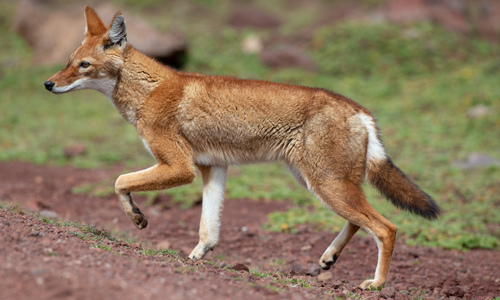
The Ethiopian wolf (Canis simensis Rüppell, 1840) matches the North American coyote in size and body build. It is larger than the black-backed jackal, side-striped jackal, and African wolf, and has comparatively longer legs. Its skull is very flat, with a long facial region that makes up 58% of the skull’s total length. The species’ ears are broad, pointed, and face forward. Its teeth, particularly premolars, are small and widely spaced; canine teeth measure 14–22 mm in length, while carnassials are relatively small. Ethiopian wolves have eight mammae, only six of which are functional. Front paws have five toes including a dewclaw, while hind paws have four toes. As is typical for members of the genus Canis, males are larger than females, with 20% greater body mass. Adult body length ranges from 841–1,012 mm (33.1–39.8 in), and adult height ranges from 530–620 mm (21–24 in). Adult males weigh 14.2–19.3 kg (31–43 lb), while adult females weigh 11.2–14.15 kg (24.7–31.2 lb). This species has short guard hairs and thick underfur that provides insulation at temperatures as low as −15 °C. Its overall coat colour ranges from ochre to rusty red, with dense whitish to pale ginger underfur. The fur of the throat, chest, and underparts is white, with a distinct white band running around the sides of the neck, and there is a sharp boundary between the red coat and white markings. The edges of the ears are thickly furred, while the inner ears are hairless. The hairless borders of the lips, gums, and palate are black. The lips, a small spot on the cheeks, and an ascending crescent below the eyes are white. The thickly furred tail is white underneath with a black tip; unlike most other canids, there is no dark patch marking the supracaudal gland. The Ethiopian wolf moults during the wet season (August–October), and there is no clear seasonal variation in coat colour, though the contrast between the red coat and white markings increases with age and social rank. Females typically have paler coats than males. During the breeding season, the female’s coat turns yellow, becomes woolier, the tail becomes brownish, and the female loses much of her tail hair. Hybrids resulting from Ethiopian wolf and dog crossbreeding tend to be more heavily built than pure Ethiopian wolves, with shorter muzzles and different coat patterns. This species is restricted to isolated pockets of Afroalpine grasslands and heathlands that are home to Afroalpine rodents. Its ideal habitat sits above the tree line, at elevations between 3,200 and 4,500 m; some wolves living in the Bale Mountains occupy montane grasslands at 3,000 m. While specimens were collected at 2,500 m in Gojjam and northwestern Shoa in the early 20th century, there are no recent records of the species occurring below 3,000 m. In modern times, subsistence agriculture that extends as high as 3,700 m has mostly restricted the species to the highest mountain peaks. Ethiopian wolves use all Afroalpine habitats, but prefer open areas with short herbaceous and grassland communities that support rodent populations, which are most abundant along flat or gently sloping areas with poor drainage and deep soils. Prime Ethiopian wolf habitat in the Bale Mountains consists of short Alchemilla herbs and grasses with low vegetation cover. Other suitable habitats include tussock grasslands, high-altitude scrubs rich in Helichrysum, and short grasslands growing in shallow soils. In its northern range, the wolf’s habitat is made up of plant communities formed by a matrix of Festuca tussocks, Euryops bushes, and giant lobelias, all of which are favoured by the wolf’s rodent prey. While marginal in importance, ericaceous moorlands at 3,200–3,600 m in Simien may act as a refuge for wolves in highly disturbed areas. Six distinct Ethiopian wolf populations are known to exist today. North of the Rift Valley, the species occurs in the Simien Mountains in Gondar, the northern and southern Wollo highlands, and Guassa Menz in north Shoa. It has recently gone extinct in Gosh Meda (north Shoa) and Mount Guna, and has not been reported on Mount Choqa for several decades. Southeast of the Rift Valley, it occurs in the Arsi and Bale Mountains. During the 1990s, wolf populations in Gosh Meda and Guguftu went extinct. In both cases, the area of Afroalpine habitat above the agricultural limit had been reduced to less than 20 km². The EWCP team confirmed the extinction of the Mount Guna wolf population in 2011, after the population had numbered fewer than 10 individuals for several years. Habitat loss in the Ethiopian highlands is directly linked to agricultural expansion into Afroalpine areas. In the northern highlands, human density is among the highest in Africa, reaching up to 300 people per km² in some areas, and almost all areas below 3,700 m have been converted into barley fields. Suitable land below this elevation remains under some level of protection in areas like Guassa-Menz and the Denkoro Reserve, as well as in the southern highlands such as the Arsi and Bale Mountains. The wolf populations most vulnerable to habitat loss are those in relatively low-lying Afroalpine ranges, such as those in Aboi Gara and Delanta in North Wollo. The Ethiopian wolf mating season usually occurs between August and November. During courtship, the breeding male follows the female closely. The breeding female only accepts advances from the pack’s breeding male, or from males of other packs. Gestation lasts 60–62 days, and pups are born between October and December. Pups are born toothless, with their eyes closed, and are covered in a charcoal-grey coat with a buff patch on the chest and abdomen. Litters contain two to six pups. Pups emerge from their den after three weeks, when their dark juvenile coat is gradually replaced with adult colouration. By five weeks of age, pups eat a combination of milk and solid food, and are completely weaned between 10 weeks and six months of age. All members of the pack help protect and feed the pups; subordinate females sometimes assist the dominant female by suckling her pups. Full growth and sexual maturity are reached at two years of age. Cooperative breeding and pseudopregnancy have both been observed in Ethiopian wolves. Most females leave their natal pack at around two years of age, and some become "floaters" that can successfully immigrate into existing packs. Breeding pairs are most often unrelated to one another, which indicates that female-biased dispersal reduces inbreeding. Inbreeding is normally avoided because it causes reduced progeny fitness (inbreeding depression), largely due to the homozygous expression of deleterious recessive alleles.