About Canis latrans Say, 1823
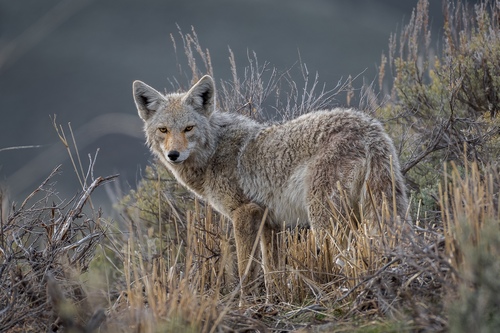
Scientific name: Canis latrans Say, 1823. Description: Male coyotes average 8 to 20 kg (18 to 44 lb) in weight, while females average 7 to 18 kg (15 to 40 lb). Size varies geographically: northern subspecies, which average 18 kg (40 lb), tend to grow larger than the southern Mexican subspecies, which average 11.5 kg (25 lb). Average total length ranges from 1.0 to 1.35 m (3 ft 3 in to 4 ft 5 in), including a 40 cm (16 in) tail. Females are shorter in both body length and height. The largest recorded coyote was a male killed near Afton, Wyoming, on November 19, 1937; it measured 1.5 m (4 ft 11 in) from nose to tail and weighed 34 kg (75 lb). Bluish-black scent glands are located on the upper side of the base of the coyote's tail. The color and texture of coyote fur vary somewhat by geography. The predominant hair color is light gray and red or fulvous, with black and white markings interspersed across the body. Coyotes living at high elevations tend to have more black and gray shades, while desert-dwelling coyotes are more fulvous or whitish-gray. Coyote fur is made up of short, soft underfur and long, coarse guard hairs. The fur of northern subspecies is longer and denser than that of southern forms; the fur of some Mexican and Central American coyote forms is almost bristly (hispid). Generally, adult coyotes (including coywolf hybrids) have a sable coat color, dark neonatal coat color, a bushy tail with an active supracaudal gland, and a white facial mask. Albinism is extremely rare in coyotes. Out of a total of 750,000 coyotes killed by federal and cooperative hunters between March 1938 and June 1945, only two had traits consistent with albinism. The coyote is typically smaller than the gray wolf, but has longer ears, a relatively larger braincase, and a thinner frame, face, and muzzle. Coyote scent glands are smaller than a gray wolf's, but are the same color. Coyote fur color shows much less variation than wolf fur color. When running or walking, the coyote carries its tail downwards, rather than horizontally as wolves do. Coyote tracks can be distinguished from dog tracks by their more elongated, less rounded shape. Unlike dogs, the upper canines of coyotes extend past the mental foramina. Habitat: Before wolves and cougars were nearly exterminated, coyotes were most numerous in grasslands inhabited by bison, pronghorn, elk, and other deer. They did particularly well in short-grass areas with prairie dogs, though they were equally at home in semiarid areas with sagebrush and jackrabbits, or in deserts inhabited by cactus, kangaroo rats, and rattlesnakes. As long as coyotes were not in direct competition with wolves, their range extended from the Sonoran Desert to the alpine regions of adjacent mountains, or the plains and mountainous areas of Alberta. After wolf extermination, the coyote's range expanded to include broken forests from the tropics of Guatemala to the northern slope of Alaska. Coyotes walk around 5–16 kilometres (3–10 mi) per day, often along trails such as logging roads and paths; they may use iced-over rivers as travel routes in winter. They are often crepuscular, more active around evening and the start of the night than during the day. However, coyotes in urban areas are known to be more nocturnal, likely to avoid encounters with humans. Like many canids, coyotes are competent swimmers, and are reported to be able to travel at least 0.8 kilometres (0.5 mi) across water. In 2026, a coyote swam to the southern edge of Alcatraz Island, over one mile from the nearest land in San Francisco. Range: Due to the coyote's wide range and abundance throughout North America, it is listed as Least Concern by the International Union for Conservation of Nature (IUCN). The coyote's pre-Columbian range was limited to the Southwest and Plains regions of North America, and northern and central Mexico. By the 19th century, the species expanded north and east, and expanded further after 1900. This expansion coincided with land conversion and the extirpation of wolves. By this time, its range encompassed the entire North American continent, including all of the contiguous United States and Mexico, extending southward into Central America, and northward into most of Canada and Alaska. This expansion is ongoing, and the species now occupies the majority of areas between 8°N (Panama) and 70°N (northern Alaska). Although it was once widely believed that coyotes were recent immigrants to southern Mexico and Central America, aided in their expansion by deforestation, Pleistocene and Early Holocene records, as well as records from the pre-Columbian period and early European colonization, show the animal was present in the area long before modern times. Range expansion occurred south of Costa Rica during the late 1970s and into northern Panama in the early 1980s, following the expansion of cattle-grazing lands into tropical rain forests. The coyote is predicted to appear in northern Belize in the near future, as the habitat there is favorable to the species. Concerns have been raised about a possible expansion into South America through the Panamanian Isthmus, if the Darién Gap is ever closed by the Pan-American Highway. This fear was partially confirmed in January 2013, when the species was recorded in eastern Panama's Chepo District, beyond the Panama Canal. A 2017 genetic study proposes that coyotes were originally not found in the area of the eastern United States. Starting in the 1890s, dense forests were transformed into agricultural land and large-scale wolf control was implemented, leaving a niche for coyotes to disperse into. There were two major dispersals from two populations of genetically distinct coyotes. The first major dispersal to the northeast came in the early 20th century from coyotes living in the northern Great Plains. These coyotes came to New England via the northern Great Lakes region and southern Canada, and to Pennsylvania via the southern Great Lakes region, meeting together in the 1940s in New York and Pennsylvania. These coyotes have hybridized with remnant gray wolf and eastern wolf populations, which has added to coyote genetic diversity and may have assisted adaptation to the new niche. The second major dispersal to the southeast came in the mid-20th century from Texas and reached the Carolinas in the 1980s. These coyotes hybridized with remnant red wolf populations before the 1970s, when the red wolf was extirpated in the wild. This hybridization also added to coyote genetic diversity and may have assisted adaptation to this new niche. Both of these two major coyote dispersals have experienced rapid population growth and are forecast to meet along the mid-Atlantic coast. The study concludes that long range dispersal, gene flow from local populations, and rapid population growth may be interrelated for coyotes. Fur and other uses: Prior to the mid-19th century, coyote fur was considered worthless. This changed after beaver populations declined, and by 1860, hunting coyotes for their fur became a major source of income for wolfers in the Great Plains, earning 75 cents to $1.50 per skin. Coyote pelts were of significant economic importance during the early 1950s, ranging in price from $5 to $25 per pelt depending on locality. Coyote fur is not durable enough to make rugs, but can be used for coats and jackets, scarves, or muffs. The majority of pelts are used for making trimmings, such as coat collars and sleeves for women's clothing. Coyote fur is sometimes dyed black to be sold as imitation silver fox. During western expansion, trappers and mountain men occasionally ate coyotes. Coyotes sometimes featured in the feasts of Plains Indians, and coyote pups were eaten by the indigenous people of San Gabriel, California. The taste of coyote meat has been compared to that of wolf, and it is more tender than pork when boiled. Coyote fat, when collected in the fall, has occasionally been used to grease leather or eaten as a spread.